
A weighted jump rope raises your heart rate faster and works your shoulders, forearms, and core harder than a standard rope, which packs more calorie burn and strength-endurance into less time. It benefits nearly everyone, from busy beginners to conditioned athletes chasing better power and rhythm. The real question isn’t whether it works. It’s which weight to start with and how to build a session that actually delivers.
TL;DR:
- Starting with a rope around a quarter to half a pound helps build proper technique without causing joint fatigue or soreness.
- Using a weighted jump rope significantly increases heart rate and muscle engagement, leading to faster cardio and strength results in shorter workouts.
- A 12-week study showed consistent weighted rope training reduces body fat and improves upper-body strength and grip endurance.
- Focus on moderate to vigorous effort, aiming for 6 to 8 out of 10 RPE or heart rate zones during intervals, rather than trying to hit specific calorie targets.
- Prioritize technique by keeping elbows close to your ribs, landing softly, and training on forgiving surfaces to avoid injury and optimize gains.
Table of Contents
- Weighted Jump Rope Benefits Start With Understanding the Tool
- The Core Benefits: Calories, Cardio, Strength, and Coordination
- What to Expect for Calorie Burn and Workout Intensity
- Which Muscles a Weighted Rope Actually Trains
- Choosing Your Rope Weight and Progressing Safely
- Sample Weighted Jump Rope Workouts You Can Start Today
- Common Mistakes and How to Train Safely
- Why Weighted Rope Training Belongs in a Home Fitness Routine
- Gear Up for Your Weighted Rope Sessions
- Sources
- FAQ
Weighted Jump Rope Benefits Start With Understanding the Tool
A weighted jump rope is exactly what it sounds like: a jump rope with added mass, usually built into the handles, the cable, or both. Most weighted ropes typically range from light to moderate weight per rope, compared to the barely-there feel of a speed rope built for fast, light rotations.
That extra mass changes the physics of every swing. A heavier rope has more rotational inertia, which means it moves slower through each turn and gives your body more time to feel the rhythm. Speed ropes reward fast wrists and quick feet. Weighted ropes reward control and full-arm rotation, which is part of why many beginners find them easier to learn.
Here’s how to choose between them:
- Pick a speed rope if your goal is maximum rotations per minute or you’re training for double-unders and rope-based sport skills.
- Pick a weighted rope if you want denser conditioning, more upper-body engagement, or a rope that’s simply easier to time and control.
- Use both if you want variety. Many home fitness setups rotate between the two depending on the day’s goal.
The Core Benefits: Calories, Cardio, Strength, and Coordination
The biggest weighted jump rope advantage is workout density. Because the added mass forces your shoulders and forearms to work through every rotation, your heart rate climbs faster than it does with a light rope, which means you get a harder cardio session in less time.
Statistic callout: A 12-week study on weighted-rope jumping in adolescent athletes found the weighted-rope group saw significant drops in body fat along with measurable gains in push-ups, sit-ups, standing long jump, and hand-grip strength. That’s a real signal that consistent weighted rope work builds more than cardio.
The main benefits break down like this:
- Calorie burn and cardio conditioning: Denser effort per minute means shorter sessions can still challenge your cardiovascular system.
- Upper-body strength-endurance: Shoulders, forearms, and upper back absorb repeated load with every turn, building endurance rather than bulk.
- Grip strength: Holding a heavier handle through hundreds of rotations taxes your forearms in a way a bare-bones rope never will.
- Coordination: The tactile feedback of a heavier rope helps you feel the rhythm sooner, which is one reason Crossrope’s guidance notes many beginners actually learn faster on a weighted rope than a speed rope.
Trainers interviewed by Prevention describe weighted ropes as one of the more efficient ways to combine strength and cardio in a single tool, especially when paired with a sensible eating pattern.
Pro Tip: If you’re new to jumping rope at all, don’t judge a weighted rope by your first ten minutes. The learning curve is real, but many people find their timing improves with consistent practice over several days.
What to Expect for Calorie Burn and Workout Intensity
You won’t find a reliable exact calorie number for weighted rope work, because it depends on your weight, the rope’s mass, and your pace. What you can count on is a faster climb to a challenging heart rate, which is why Crossrope’s trainers point to 10 to 20 minute sessions as plenty for most people.
Instead of chasing a calorie figure, track intensity with cues you can actually feel:
- Rate of perceived exertion (RPE): Aim for a 6 to 8 out of 10 during work intervals. You should be breathing hard but not gasping.
- Heart-rate zones: A fitness tracker or smartwatch can confirm you’re in a moderate-to-vigorous zone, which is where most of the conditioning benefit lives.
- Interval formats: Try Tabata (20 seconds on, 10 seconds off, eight rounds), EMOM (one minute of jumping every minute for 10 to 15 minutes), or classic 30 seconds on, 30 seconds off circuits.
Shorter, harder intervals with a weighted rope typically beat longer, easier sessions with a light one for overall conditioning.
Which Muscles a Weighted Rope Actually Trains
The added mass shifts where you feel the work, and understanding that mapping helps you train with purpose instead of just swinging away.
- Deltoids and rotator cuff stabilizers: Every rotation asks your shoulders to control the rope’s swing, which builds shoulder endurance over time.
- Upper back and forearms: Holding tension through hundreds of reps trains your grip and upper-back muscles the way a light rope simply can’t.
- Core: Staying upright and rhythmic through each jump demands constant anti-rotation work from your abs and obliques.
- Calves and ankle stabilizers: The plyometric landing, over and over, loads your lower legs in a way that builds ankle resilience, as detailed in this plyometric exercises guide, though it also means impact matters (more on that below).
Where the weight sits changes the emphasis. Handle-weighted ropes load your grip and forearms hardest, since the mass is concentrated where you hold on. Cable-weighted ropes distribute more of the load through the swing itself, which can shift some of the demand toward your shoulders and upper back. Neither is better across the board. It’s worth matching the rope to what you’re trying to build.
Choosing Your Rope Weight and Progressing Safely
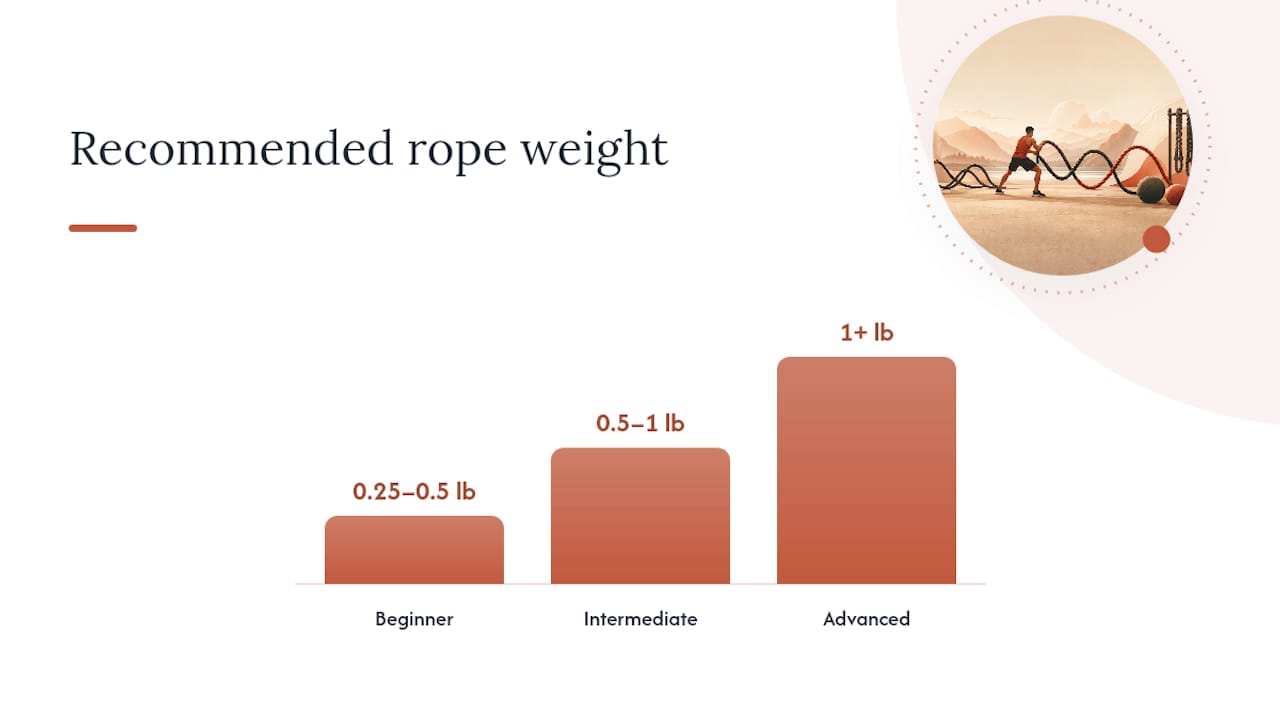
Starting too heavy is the most common mistake, and it usually shows up as sore wrists or a rope that never quite finds a rhythm. Crossrope’s guidance recommends beginners start around a quarter to half a pound, since the lighter load still gives useful feedback without overwhelming your shoulders before your technique catches up.
Once your timing is solid, here’s how to know you’re ready to progress:
- You’re hitting clean, consistent reps without the rope catching your feet.
- Your shoulders feel fatigued but not painful after a session.
- Your grip holds up for the full workout without needing to reset your hands.
- You can sustain 2 to 3 minutes of continuous jumping without breaking form.
Intermediate and advanced exercisers typically move to half a pound up to a pound or more for short, intense conditioning intervals. If you’re testing a rope in person, check that the handles sit comfortably in your palm and that the cable length matches your height. A rope that’s too long forces you to jump wider than necessary, which wastes energy and throws off your rhythm.
Pro Tip: When in doubt, size down. A slightly lighter rope you can control cleanly builds better long-term technique than a heavier one you’re fighting through every rep.
Sample Weighted Jump Rope Workouts You Can Start Today
You don’t need a complicated plan to start feeling the benefits of weighted jump rope training. These four templates cover the range from first-timer to strength-endurance focused.
- Beginner timing workout: 8 rounds of 30 seconds jumping, 60 seconds rest. Focus entirely on rhythm, not speed.
- Conditioning EMOM: Jump for 45 seconds at the start of every minute for 12 to 15 minutes. The 15 seconds of rest before the next minute keeps intensity honest.
- Strength-endurance intervals: Switch to your heaviest comfortable rope and jump in 20 to 40 second bursts with 90 seconds of rest between rounds. This is where grip and shoulder endurance build fastest.
- HIIT finisher: Three rounds of two minutes of continuous jumping with a full 2 minute rest between rounds, ideal tacked onto the end of a strength session.
Warm up your wrists and shoulders with arm circles and light rope swings before any of these, and always finish with a few minutes of walking to bring your heart rate down gradually. For best results, pair two or three weighted rope sessions a week with a short home workout routine built around compound strength moves, and give your shoulders at least one rest day between rope-heavy workouts.
Common Mistakes and How to Train Safely
Most weighted rope injuries come from technique, not the rope itself. Elbow flare is the most frequent issue: keep your elbows close to your ribs and let your wrists do the small rotational work while your shoulders stay relatively still. Turning entirely from the wrist, on the other hand, causes fatigue and sloppy timing fast.
- Fix elbow flare by picturing your upper arms glued lightly to your sides.
- Fix hard landings by jumping just high enough to clear the rope, landing softly on your midfoot rather than your heels.
- Skip weighted rope work if you have a recent shoulder or knee injury, and check with a physical therapist or doctor before restarting.
- Train on a forgiving surface like a rubber mat or turf, not concrete, and wear shoes with real cushioning to reduce joint stress.
- Cap your volume early on. Two to three short sessions a week is plenty while your joints adapt.
Why Weighted Rope Training Belongs in a Home Fitness Routine
A weighted jump rope earns its place in a home setup precisely because it asks so little of your space and so much of your session. Pair a few weekly rope intervals with a handful of strength basics like functional bodyweight moves, and you’ve got a complete conditioning routine in a corner of a living room.
What actually keeps people consistent, though, isn’t the workout plan. It’s whether the gear feels good to use. A rope with a comfortable grip, apparel that doesn’t ride up mid-jump, and a way to see your heart rate climbing in real time all matter more than most people admit. That’s the thinking behind how Couchanddumbells approaches home fitness: gear that looks intentional in your space and performs when you’re actually sweating in it.
— Brian Dunn, Couch & Dumbbells
Gear Up for Your Weighted Rope Sessions
Once your rope work is dialed in, the right apparel and tracking tools make every session easier to stick with. Couchanddumbells is built for exactly this kind of home training: apparel that moves with you through fast rotations and a smartwatch that tracks your heart rate so you’re not guessing whether you actually hit your target zone.

If you’re building out a full home conditioning corner, the Fitness & Gear collection has apparel, tracking devices, and strength accessories curated to pair with rope-based cardio. Browse the collection and outfit your next session before you pick your rope back up.
Sources
- Effect of weighted rope jumping programme on body composition and strength performance (2017)
- Weighted Jump Rope Benefits + How to Choose the Right Weight – Crossrope
- Trainers say weighted jump ropes have surprising benefits – Prevention
FAQ
Do weighted jump ropes actually work?
Yes. A 12-week study on weighted-rope training found measurable reductions in body fat and gains in strength markers like grip strength and push-up performance, and trainers consistently describe them as an efficient way to combine cardio and strength-endurance.
How heavy of a weighted jump rope should I get?
Beginners should start around a quarter to half a pound, according to Crossrope’s guidance, then progress toward one pound or more once your timing and shoulder endurance improve.
What is 10 minutes of jumping rope equivalent to?
Ten minutes of weighted rope work at a challenging pace can raise your heart rate similarly to a much longer light-cardio session, since the added mass forces denser effort in less time, though exact calorie equivalents vary by body weight and pace.
Can jumping rope burn belly fat?
Jumping rope, weighted rope included, contributes to overall calorie burn and fat loss when combined with a calorie-controlled diet. The 2017 adolescent-athlete study found reduced body fat after 12 weeks of weighted-rope training, but no single exercise targets fat loss in one specific area.