
Two measurements tell you almost everything: your rib cage (underbust) and your bust at its fullest point. Subtract the first from the second, map the difference to a cup letter, and let your rib measurement set your band size, rounding by the method below. That combination gives you a starting size. From there, the fit tests later in this guide confirm whether that number actually works on your body.
TL;DR:
- Measure your rib cage snugly below your bust using a level tape, then round to the nearest even number unless your brand states otherwise.
- Subtract your rib measurement from the fullest bust measurement to determine your cup size, with a 2 to 3 inch difference indicating a C cup.
- For high-impact activities, size down at least one band size to accommodate stretching during movement, ensuring proper support.
- Check fit by testing the band snugness, strap comfort, cup fullness, and bounce control through movement to confirm support and comfort.
- Regularly remeasure and replace your sports bra if the band feels slack despite proper care or ongoing support, especially after many wears or washes.
Table of Contents
- How to Measure Yourself for a Sports Bra
- How to Convert Measurements Into Band and Cup Sizes
- Sports-Bra Styles and Support Levels
- How to Check a Sports Bra Actually Fits
- Common Fit Problems and Practical Fixes
- Publisher Expertise: What Couch & Dumbbells Recommends
- How to Care for Your Sports Bra to Keep It Fitting Right
- Accounting for Breast Shape and Asymmetry
- When to Size Up or Down for Different Activities
- What the Research on Fit Actually Supports
- Find Fitness Apparel Built Around Real Fit
- Sources
- FAQ
How to Measure Yourself for a Sports Bra
Grab a soft tape measure and, ideally, a friend to help you keep it level. You’ll get more accurate results wearing a thin, non-padded bra or no bra at all. Stand naturally, breathe normally, and don’t suck in or puff out your chest. Posture changes the number more than people expect.
Here’s the process, step by step:
- Measure your rib cage. Wrap the tape directly under your bust, snug against your ribs, level all the way around. It should feel firm but not compressive, like a hug rather than a squeeze.
- Round to a workable band number. If you land on an odd number or a half inch, round to the nearest even number for standard American sizing, or keep the raw number if you’re shopping a brand that uses odd-numbered bands.
- Measure your bust. Keep the tape level across your back and directly over the fullest part of your breasts, usually at nipple height. Don’t let the tape sag in the back or ride up in front.
- Calculate the difference. Subtract your rib measurement from your bust measurement. That number in inches maps to a cup letter (the chart below shows exactly how).
- Note asymmetry. If one side measures noticeably larger, record both numbers. You’ll size for the larger side and manage the smaller one with padding or a soft cup insert.
If you’re measuring alone, a phone propped on a shelf with the camera angled at your ribcage can help you check that the tape stayed level. A length of string marked with a pen and then measured against a ruler works in a pinch if you don’t own a flexible tape measure. For a broader rundown of at-home lingerie measuring technique, Lingerie Seduction’s home measuring guide covers the same fundamentals from a general fit perspective.
Pro Tip: Measure twice, on two different days if you can. Bloating, hydration, and even the time of day shift your rib measurement by half an inch or more, and that’s enough to change which band size fits.
How to Convert Measurements Into Band and Cup Sizes
The math is simpler than most size charts make it look. Runner’s World’s sizing guide uses the same difference method most fitting specialists rely on: your bust measurement minus your rib measurement tells you the cup.
Here’s how that translates in inches:
- 0 to 1 inch difference: AA/A cup
- 1 to 2 inches: B cup
- 2 to 3 inches: C cup
- 3 to 4 inches: D cup
- 4 to 5 inches: DD/E cup
- 5 to 6 inches: DDD/F cup
Your band number comes from the rib measurement itself, rounded per the method in the previous section. So a 30-inch rib rounds to a 30 band; a 33-inch rib might round to 32 or 34-inch depending on the brand’s rounding convention.
Worked example: Rib measures 30 inches, bust measures 34 inches. The difference corresponds to a D cup range. Your starting size is 30D, or a 32D if you prefer a slightly looser band with a tighter cup fit (bands and cups are interchangeable in small steps, called “sister sizing”).
General size labels (XS to XL) vary by brand because there’s no shared industry standard mapping numeric sizes to letters. A 32C might be a size Small at one brand and Medium at another, which is exactly why REI’s fitting guide recommends treating your calculated number as a starting point, not a final answer.
Sports-Bra Styles and Support Levels
Sports bras generally fall into three construction types, and picking the right one matters as much as getting the number right. University research on sports bra performance found that construction details like band width and cup shaping materially change how well a bra controls movement during high-impact activity.
- Compression bras flatten breast tissue against the chest with a single stretchy layer. They work well for smaller cups and lower-impact movement like walking or yoga.
- Encapsulation bras shape and support each breast individually, similar to a regular bra’s cup construction. This style tends to suit fuller cups because it distributes weight rather than just pressing it flat.
- Hybrid bras combine both approaches, compressing overall while shaping each cup. These handle high-impact activities like running or HIIT training best, especially for C cups and above.
Compression-only designs generally suit A to B cups and low-to-medium impact activities unless the bra includes adjustable straps or a wider underband to add support. Fit features matter here too: a wider band distributes tension across more skin, adjustable straps let you fine-tune lift, and hook-and-eye closures give you room to adjust as the band stretches over time.
Pro Tip: If you’re between two support levels, size toward the higher-support option. A bra that’s slightly more supportive than you need is a minor inconvenience; one that’s not supportive enough during a run is a real problem.
How to Check a Sports Bra Actually Fits
Trying it on is the part measuring can’t replace. Run through these checks before you decide a size works:
- Band test. Hook it on the loosest setting and slide two fingers under the band at your back. It should feel snug, not loose enough to shift and not so tight it leaves marks immediately.
- Strap test. Slide two fingers under each strap at the shoulder. If they dig in, the band is likely too loose and the straps are compensating. If they slip off, tighten them or size down the band.
- Cup check. Look for gaps, wrinkles in the fabric, or tissue spilling over the top or sides. Any of these means the cup size needs adjusting, even if the band feels right.
- Movement test. Jump or run in place for 30 seconds. A properly fitting high-impact bra visibly limits bounce; if you feel significant movement or discomfort, the size or style isn’t right yet.
That last step isn’t optional. Research on sports bra construction points to movement testing as the most reliable way to validate real-world support, since a bra can look and feel fine standing still and fail completely once you move.
Because band fit provides most of a sports bra’s actual support, start troubleshooting there before you blame the cup.
Common Fit Problems and Practical Fixes
Most fit complaints trace back to one of a handful of causes, and nearly all of them have a straightforward fix.
- Chafing along the band or straps: Look for a softer band material, apply an anti-chafe balm before workouts, and check whether a seam is sitting directly on skin that rubs during movement.
- Spillage or overflow at the top or sides: This almost always means the cup is too small. Try a size up in the cup, or switch from compression to an encapsulation or hybrid style that shapes rather than flattens.
- Band rides up your back: The band is too loose, or the style doesn’t suit your torso shape. Size down the band and confirm it sits under your breast tissue, not compressing across it.
- Straps dig in or constantly slip: Wider straps or a racerback design spreads pressure more evenly. Don’t crank the straps tighter to fix a band problem. That just shifts the strain to your shoulders.
Pro Tip: Keep more than one sports bra in rotation by impact level. A hybrid style for running days and a compression style for yoga or walking will each fit better than one bra trying to do both jobs.
If you’re building out a full workout wardrobe alongside your bra, pairing it with supportive bottoms like performance leggings rounds out a kit that actually holds up during high-impact sessions.
Publisher Expertise: What Couch & Dumbbells Recommends
Couch & Dumbbells built its fitness apparel line around the same principle behind this guide: fit determines whether performance gear actually gets used. Belle, who covers fit and sizing for Couch & Dumbbells, developed this measurement-first approach after seeing how often generic size charts fail real bodies.
- Every fitness apparel product page includes a detailed size chart specific to that garment, because sizing standards vary meaningfully across brands.
- The team reviews fit feedback from customer returns to refine size chart accuracy over time, rather than relying on a single generic template.
- If a size doesn’t work once you try it, exchanges are straightforward. Check the product page’s specific return window before ordering.
Use your calculated size as your starting point when shopping, then confirm with the band, strap, cup, and movement tests above before committing to a size.
How to Care for Your Sports Bra to Keep It Fitting Right
A sports bra loses its support gradually, and most of that loss comes from how it’s washed and dried, not just how often it’s worn. Heat is the biggest enemy of the elastic fibers that give a band its snap-back tension.
Wash sports bras in cold water, ideally in a mesh laundry bag to protect the fabric from friction against zippers and hooks. Skip the dryer entirely. High heat breaks down spandex and elastane fibers faster than almost anything else you do to the garment, and a band that’s lost its stretch memory will never fit the way it did on day one. Lay bras flat to air dry instead.
Fasten hook closures before washing so they don’t snag on other fabric, and avoid fabric softener, which coats elastic fibers and reduces their ability to snap back into shape. Rotating between two or three bras rather than wearing one every single day also matters. Elastic needs recovery time between wears to maintain its stretch, similar to how running shoes need rest between hard workouts.
If a band has gone slack despite good care, that’s a sign it’s time to remeasure and replace, not a sign to size down and compensate. A stretched-out 32 band pretending to be a 30 will never distribute support the way a properly sized band does.
Accounting for Breast Shape and Asymmetry
Two people with identical measurements can need different sizes because breast shape changes how tissue sits inside a cup. Fuller-on-bottom shapes typically fill out the lower cup first and may need a slightly larger cup with a supportive underwire-free structure to prevent spillage at the top. Fuller-on-top or “east-west” shapes, where breasts point outward rather than forward, often benefit from encapsulation styles that pull tissue toward the center rather than compression styles that push it outward.
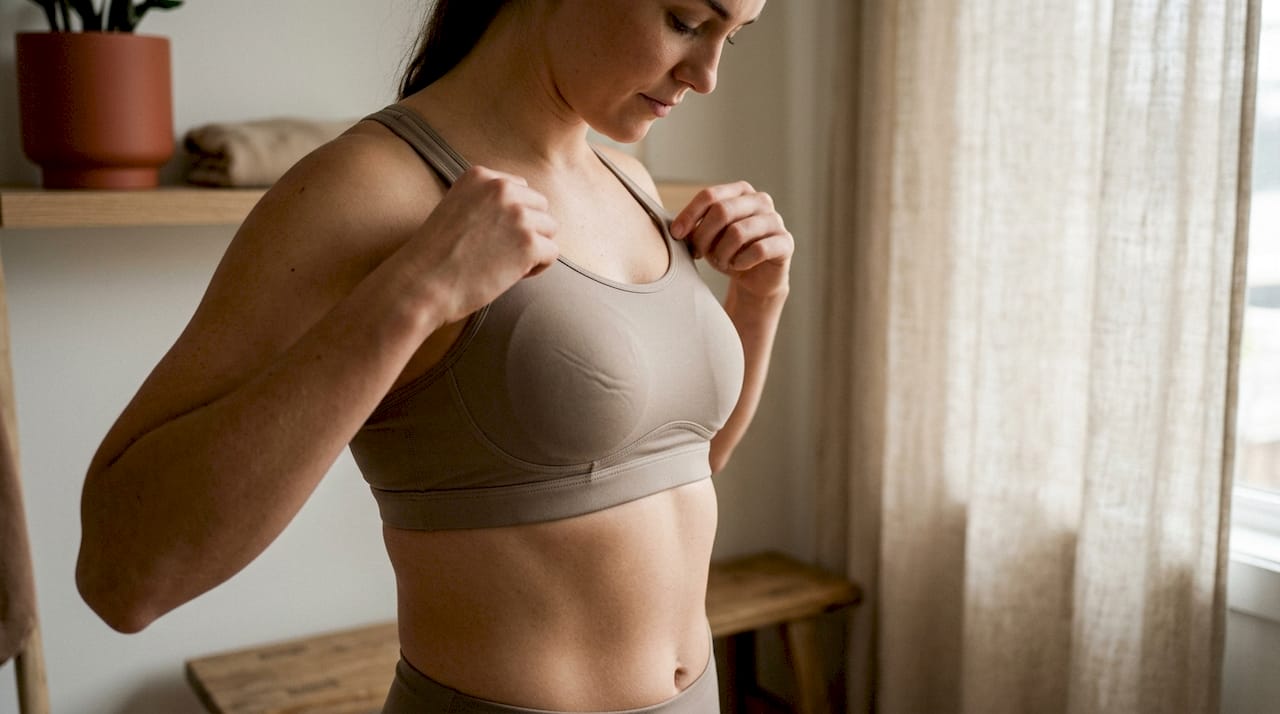
Asymmetry, where one breast is noticeably larger than the other, is common and rarely dramatic enough to require a specialty bra. Measure both sides and size for the larger one. A thin, removable pad on the smaller side evens things out without affecting support on either side. Avoid the instinct to size down to make the smaller breast look proportional. That approach compresses the larger side uncomfortably and can cause the exact spillage and chafing problems covered earlier.
If you have a significant size difference between sides, look for styles with individually adjustable straps rather than a fixed racerback. Independent strap adjustment lets you fine-tune lift and coverage on each side separately, which fixed-strap styles simply can’t do.
When to Size Up or Down for Different Activities
Your “correct” size according to measurement isn’t always the size you should buy for every workout. High-impact activities like running or jump training generally call for sizing toward a tighter band, sometimes one size down from your calculated number, because bands stretch with sweat and repeated motion throughout a session. A band that fits perfectly at rest can loosen noticeably 20 minutes into a run.
Low-impact activities like restorative yoga, walking, or strength training with controlled movement give you more flexibility. Sizing at your exact calculated number, or even slightly looser for breathing comfort during stretching, usually works fine here.
Comfort preference matters too, and there’s no penalty for prioritizing it. Some people prefer a slightly looser band for all-day wear during errands or light activity, accepting a small trade-off in support for a reduction in pressure. Others prefer maximum compression for peace of mind even during lower-impact sessions. Neither approach is wrong. The measurement gives you a scientifically grounded starting point; how you adjust from there depends on what your body and your workout actually demand that day.
What the Research on Fit Actually Supports
The biggest gap in most sports bra advice is treating measurement as the finish line instead of the starting point. Numbers get you close. They don’t account for how a specific brand cuts its bands, how your breast shape fills a cup, or how a garment behaves once you’re moving instead of standing still in a fitting room. That’s why the fit tests in this guide carry as much weight as the tape measure.
The conventional wisdom oversells precision. People treat a calculated band and cup size like a fixed fact, then blame their body when a “correct” size doesn’t feel right. Usually the size was never wrong. It just needed a different style, a different brand, or a jump or run test that a standing-still measurement can’t replicate.
If you take one thing from this guide, prioritize the movement test over everything else. A band that passes the two-finger check and a cup with no visible gaps can still fail the moment you start moving, and that failure is the one that actually matters during a workout.
— Brian Dunn, Couch & Dumbbells
Find Fitness Apparel Built Around Real Fit
Getting your sports bra size right is only half the equation. The rest is finding apparel that holds its shape and support wear after wear, which is exactly what Couch & Dumbbells builds its fitness line around. Instead of guessing at a size chart written for one generic body type, you get product pages with garment-specific measurements and a straightforward exchange process if the first size doesn’t land.

Couch & Dumbbells pairs performance apparel with the same attention to fit and construction quality that goes into its home furnishings line, so what you wear to train holds up the same way your favorite pieces at home do. If you’re building out a full activewear rotation, check the hip fitness pants or the CurveBoost fitness leggings for bottoms that match the support level of a properly fitted top. Browse the fitness and gear collection to start building a workout wardrobe sized around how you actually move, not just how a chart says you should fit.
Sources
- How the characteristics of sports bras affect their performance | University research
- How to size a sports bra: an expert’s guide to finding gear that fits | Runner’s World
- Sports bras: sizing & measuring | REI Expert Advice
FAQ
Should a Sports Bra Be the Same Size as Your Regular Bra?
Not always. Your rib and bust measurements stay the same, but sports bras often run differently in the band and cup due to compression fabric and construction, so treat your regular bra size as a reference point rather than an exact match.
Can You Measure Your Bra Size While Wearing a Sports Bra?
No. Compression fabric flattens and shifts breast tissue, which distorts the measurement. Measure in a thin, non-padded bra or no bra at all for accurate numbers.
How Do You Convert a Regular Bra Size to a Sports Bra Size?
Start with your rib and bust measurements rather than converting an existing size. Subtract rib from bust to find your cup, and use your rounded rib measurement as your band, since brand sizing isn’t standardized enough for a reliable direct conversion.
What Sports Bra Size Is a 34C?
A 34C typically means a 34 inch band with roughly a 2 to 3 inch difference between rib and bust measurements. The exact fit still depends on the brand, so use 34C as a starting size to try, then confirm with the band, strap, cup, and movement tests covered above.