

Performance fabric sofas are specially made or treated to resist spills, stains, and everyday wear, which makes them the practical choice for homes with kids, pets, or heavy daily use. The trade-off is that “performance” isn’t one standard: some fabrics build resistance into the fiber itself, while others rely on a surface coating that wears off. Worth it? Almost always, but only if you check the spec sheet before you check the color swatch.
TL;DR:
- Engineered fiber construction generally outlasts surface coatings because it provides long-term stain and abrasion resistance.
- Double rub ratings below 15,000 indicate low durability suitable only for occasional use, while 30,000+ double rubs are ideal for heavy traffic homes.
- Look for specific spec sheet details like fiber type, double rub count, care codes, and warranty terms to ensure the fabric matches household needs.
- Recycled polyester content in performance fabrics can offer a more sustainable option, but natural fibers tend to be less common and more costly.
Table of Contents
- What Makes a Sofa “Performance Fabric” Instead of Regular Upholstery?
- Engineered Fibers vs. Surface Coatings: What Actually Lasts?
- Which Performance Fabric Type Fits Your Home?
- What Do Double Rubs and Colorfastness Ratings Actually Mean?
- How Do You Clean and Care for Performance Fabric Sofas?
- How Do You Choose the Right Performance Fabric Sofa?
- Can Performance Fabric Sofas Still Look Elegant?
- Are Performance Fabrics Actually Better for the Environment?
- Performance Fabric vs. Leather: Which Actually Holds Up Better?
- What Warranties Come With Performance Fabric Sofas?
- We choose performance fabrics with durability in mind while maintaining style. A sofa that looks beautiful for six months and then shows every coffee ring isn’t a good deal no matter what it cost.
- Ready to Shop Performance Fabric Seating?
- Where to Verify Fabric Claims Yourself
- Sources
- FAQ
What Makes a Sofa “Performance Fabric” Instead of Regular Upholstery?
“Performance fabric” is a broad marketing category, not a single material or a certified standard. It typically refers to upholstery engineered for enhanced durability, stain resistance, and easy cleaning, most often built from synthetic fibers like polyester, acrylic, or olefin rather than one specific fiber type, according to the Fabric Resource performance and outdoor fabric guide. Two sofas can both wear the “performance” label and behave completely differently in your living room.
That’s why the term describes an approach to construction or treatment, not a guaranteed outcome. A fabric might earn the name through:
- Fiber-level engineering — stain resistance and colorfastness built into the yarn before weaving
- Woven density and structure — tighter weaves that resist abrasion and pilling
- Surface treatments — sprays or coatings applied after the fabric is finished
- Blended synthetics — polyester, acrylic, or olefin combined for cost and performance balance
The label alone tells you almost nothing about which of these you’re getting. Reading the actual spec sheet, not the marketing copy, is the only way to know whether you’re buying a fabric engineered for the long haul or one that just got a spray treatment before shipping.
Engineered Fibers vs. Surface Coatings: What Actually Lasts?
The single biggest quality gap in performance upholstery comes down to where the performance lives: in the fiber, or on top of it.
Engineered performance fabrics build resistance into the fiber or yarn itself, often through solution dyeing, where color and protective properties are added during fiber production rather than sprayed on afterward. Fabrics built this way generally outlast topical coatings, which can wear away and lose effectiveness with regular use and cleaning, according to Apparel Search’s overview of performance fabrics.
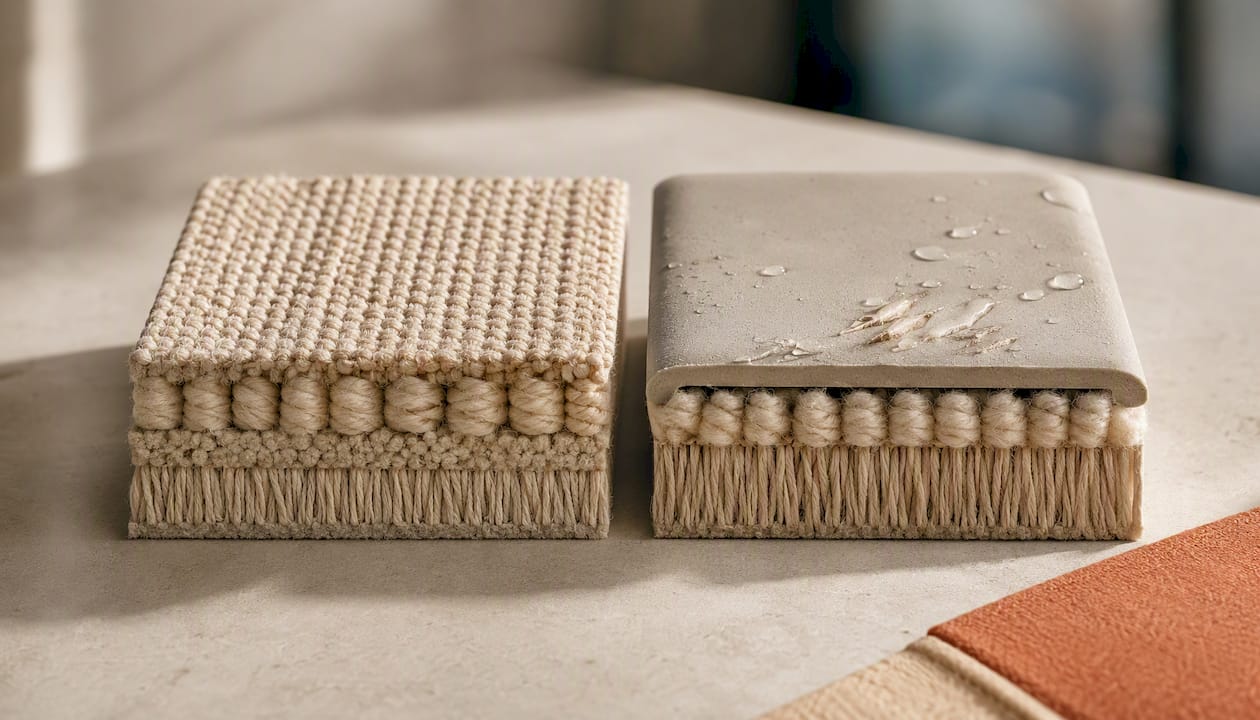
Coated finishes work differently. A stain-repellent spray applied to standard fabric can repel spills impressively on day one, but that layer degrades with friction, vacuuming, and cleaning cycles. Reapplication is often necessary to maintain the same protection, and most homeowners never think to do it. The fabric looks “performance” on the tag long after it has stopped acting that way.
For everyday practical purposes: if your sofa sees daily use, kids doing homework on it, a dog who thinks it’s his, engineered fiber construction is the more reliable long-term investment. Coated fabrics can still be a smart, budget-friendly choice for lower-traffic rooms, but treat any spill resistance claim on a coated fabric as temporary rather than permanent.
Which Performance Fabric Type Fits Your Home?
Not all performance fibers behave the same way, and matching the fiber to your household matters more than matching the color to your Pinterest board.
- Solution-dyed acrylic holds color exceptionally well because pigment is added before the fiber is even formed, so fading from sun exposure or repeated cleaning is minimal. It also has a soft hand-feel that reads closer to natural cotton than most synthetics.
- Olefin (polypropylene) is one of the most water-resistant fibers available and tends to be the most affordable of the performance group, making it a strong pick for basements, playrooms, or first sofas.
- Polyester microfiber offers a soft, almost suede-like texture with strong abrasion resistance, which is why it shows up so often on family room sectionals.
- Textured weaves like bouclé and chenille bring visual depth and a cozy look, but their looped or fuzzy surface can trap crumbs and pet hair more than a flat weave, so factor in vacuuming frequency.
Many performance lines now also incorporate recycled polyester content, giving shoppers a sustainability angle without giving up stain resistance.
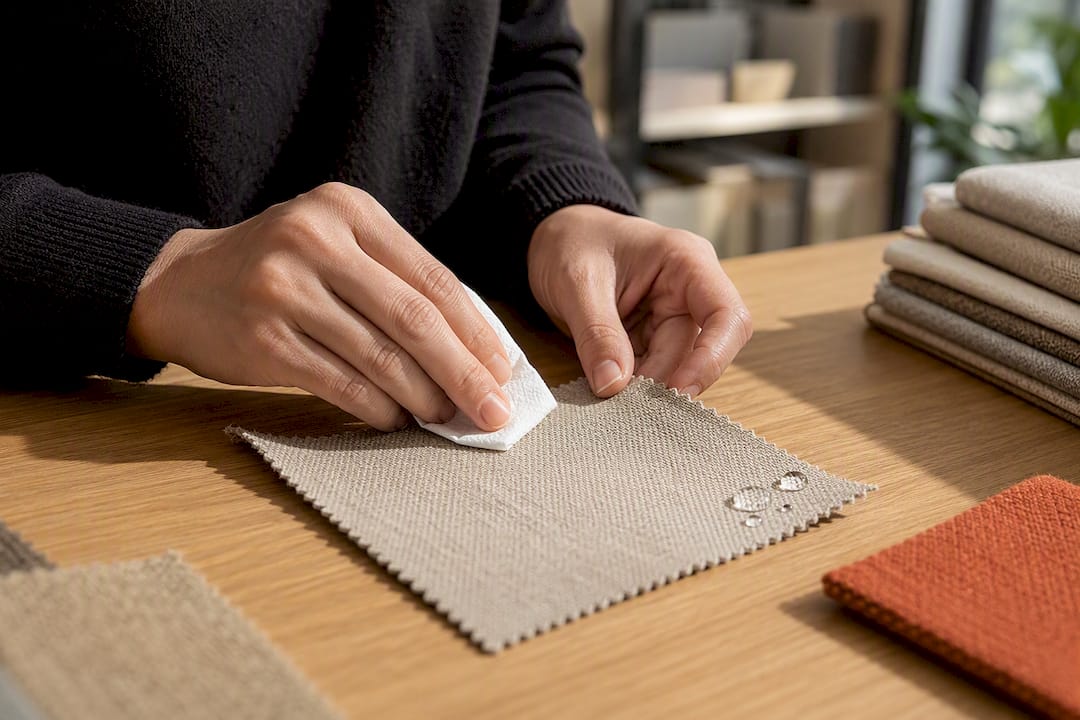
Pro Tip: Order a fabric swatch before you buy anything. Rub it with a paper towel, dab a little water on it, and see how it actually feels and behaves rather than trusting a product photo.
What Do Double Rubs and Colorfastness Ratings Actually Mean?
Spec sheets throw around numbers that sound technical but translate to very concrete real-world outcomes once you know what to look for.
Double rubs measure abrasion resistance using the Wyzenbeek or Martindale test methods, where a mechanical arm rubs fabric back and forth (or in a figure-eight pattern) until visible wear appears. Textile performance testing, as outlined by the broader performance textiles standards on Wikipedia), evaluates fabric across abrasion, colorfastness, pilling, and dimensional stability, and these numbers are meant to predict real-world lifespan, not just impress on a tag.
As a practical comparator, residential-grade upholstery fabric commonly rates in the 15,000 to 30,000 double rub range, while heavy-use or contract-grade fabrics (built for offices, hospitality, or families that treat the sofa like a trampoline) push considerably higher.
A few numbers worth watching for on any spec sheet:
- Double rubs under 15,000: light or occasional-use pieces, not ideal for a primary family sofa
- 15,000 to 30,000 double rubs: standard residential durability
- 30,000+ double rubs: heavy residential or light commercial durability
- Colorfastness rating: how well the fabric resists fading from light exposure and cleaning; look for a numeric grade rather than a vague “fade resistant” claim
- Pilling grade: higher grades mean fewer of those little fuzz balls after months of sitting and sliding
If a listing gives you a color and a price but no double-rub number, that’s a gap worth asking about before you commit.
How Do You Clean and Care for Performance Fabric Sofas?
Every performance fabric ships with a care code, usually a letter (W, S, WS, or X) tucked into the tag or product description, and it’s the single most useful piece of information on the entire sofa.
- W means water-based cleaners are safe
- S means solvent-based cleaners only
- WS means either works
- X means vacuum only, no liquid cleaners at all
Following that code matters more than any brand-name cleaner you buy, because the wrong cleaner on the wrong fabric can set a stain permanently or damage the fiber’s finish.
For an actual spill, speed matters more than product:
- Blot immediately with a clean, dry cloth or paper towel, working from the outside of the stain inward so you don’t spread it.
- Apply the correct cleaner based on the care code, a small amount of mild soap and water for W-rated fabrics, a solvent cleaner for S-rated ones, and blot again rather than rub.
- Let it air dry fully before sitting on the spot or judging whether the stain is actually gone; some stains look worse wet than they end up dry.
Routine care matters as much as emergency response. Vacuum weekly with an upholstery attachment, rotate seat cushions every few weeks to even out wear, and always spot-test any new cleaner on a hidden section, like the back of a cushion, before applying it to a visible stain.
Pro Tip: Keep a small labeled bottle of the manufacturer-recommended cleaner in a hallway closet. When a spill happens, you won’t waste ten minutes hunting for the right product while a stain sets.
How Do You Choose the Right Performance Fabric Sofa?
The checklist changes depending on who’s actually sitting on the sofa every day, and being honest about your household upfront saves you from an expensive mismatch.
For homes with pets: prioritize tight, flat weaves over loopy textures (claws snag loops), and look for olefin or solution-dyed acrylic with a W or WS care code so accidents are easy to handle.
For homes with young kids: go engineered over coated every time, and lean toward a higher double-rub count since kids treat sofas as furniture, trampoline, and fort simultaneously.
For formal or low-traffic spaces: you have more flexibility to prioritize texture and softness, since a coated finish or lower double-rub rating is less of a liability when the room sees light use.
Before buying, request these specifics from the retailer or spec sheet:
- Fiber content and whether the color is solution-dyed or surface-dyed
- Double-rub count and testing method (Wyzenbeek or Martindale)
- Care code (W, S, WS, or X)
- Whether cushion covers are removable and machine washable
- Warranty terms specific to the fabric, not just the frame
Roughly two-thirds of retailer product pages that describe fabrics as “performance” or “stain-resistant” pair those claims with cleaning instructions and warranty details, but that consistency isn’t universal, so treat a vague claim with no backup as a red flag, not a formality.
Red flags to walk away from: marketing copy that says “stain-resistant” with no care code listed anywhere, a fabric described only as a coating with no fiber content disclosed, or a warranty that covers the frame but explicitly excludes the fabric. If a retailer can’t answer a direct question about double-rub count, that’s information they should have on hand.
One more distinction worth knowing before you shop: performance fabric is not the same as outdoor fabric. Outdoor textiles add UV and mildew resistance that most indoor performance fabrics simply don’t have, per Fabric Resource’s guide, so don’t assume an indoor performance sofa can handle a sunny porch, or that an outdoor-rated piece is somehow overkilled for a living room.
Can Performance Fabric Sofas Still Look Elegant?
Yes, and this is where engineered fabrics quietly changed what “practical” is allowed to look like. Older stain-resistant options meant dark colors and rough textures. Engineered performance fabrics now let homeowners use lighter colors and softer textures in active rooms, because modern fiber-level treatments improve cleanability and abrasion resistance without limiting the palette, according to Milliken’s overview of performance fabrics.
Pattern and texture can also do quiet defensive work. A subtle two-tone weave or a fine tweed hides minor wear and small stains far better than a flat solid, especially in a heavily used family room. Pair your fabric choice with a higher-density cushion fill; a great fabric on a cushion that flattens in a year still looks tired, no matter how stain-resistant the cover is.
If you’re carving out a multi-use living space, matching a durable sofa to the rest of the room’s function matters, too — explore ideas from the Coffee Bar Furniture Styles Guide for Premium Home Stations to integrate seating seamlessly into designed living spaces. Explore ideas for blending fitness equipment with home decor if your living room doubles as a workout corner, or read more on choosing sofa style without sacrificing comfort for a deeper look at balancing looks with livability.
Are Performance Fabrics Actually Better for the Environment?
The sustainability picture here is mixed, and worth understanding before you assume “durable” automatically means “eco-friendly.”
The case for performance fabrics: longevity itself is a form of sustainability. A sofa that resists tearing, pilling, and fading and stays cleanable for years reduces the need for early replacement, which cuts down on the manufacturing and landfill impact of constantly cycling through furniture, an outcome noted in reporting on performance fabric benefits. A sofa you keep for twelve years instead of five is doing real environmental work regardless of what the fabric is made from.
The complicating factor: most performance fabrics are synthetic, built from polyester, acrylic, or olefin, all of which are derived from petroleum and shed microplastics during washing and normal wear. That’s a real cost that durability doesn’t fully offset.
Some manufacturers have started incorporating recycled polyester content into performance lines, giving you a fiber source that reduces virgin plastic use while keeping the same durability profile. If sustainability is a priority alongside stain resistance, ask specifically whether recycled content is used and what percentage, since “eco-friendly” on a tag can mean almost anything without a number attached. Natural performance alternatives exist too, but they’re less common and usually carry a higher price and lower stain resistance than their synthetic counterparts.
Performance Fabric vs. Leather: Which Actually Holds Up Better?
The comparison usually comes down to what kind of mess you’re planning for, because leather and performance fabric fail differently rather than one simply beating the other.
Leather resists spills on the surface reasonably well since liquid tends to bead rather than soak in immediately, but it’s vulnerable to punctures, scratches from claws, and cracking over time, especially in dry climates or rooms with direct sun exposure. Once leather cracks or scratches, repair is difficult and often visible permanently. It also requires conditioning every few months to prevent that drying out.
Performance fabric handles a wider range of everyday damage better: it won’t crack, doesn’t show claw marks the way leather does, and a well-engineered version resists staining as well as leather resists spills, sometimes better, depending on the specific fabric and finish. The trade-off is that performance fabric generally can’t match leather’s clean, minimal aesthic or its multi-decade lifespan when leather is properly cared for.
For households with pets, active kids, or anyone who has ever set a hot mug directly on furniture without a coaster, performance fabric is usually the lower-maintenance, lower-risk choice. For a formal, low-traffic room where the goal is a long-term investment piece, quality leather still has a legitimate case. Cost is a factor too: genuine leather sofas typically carry a higher price point than comparable performance fabric pieces, without a proportional gain in daily livability for most households.
What Warranties Come With Performance Fabric Sofas?
Warranty coverage on performance fabric sofas varies more than shoppers expect, and the fine print matters as much as the length of coverage.
Frame warranties are the most common and often the longest, sometimes running a decade or more, since structural wood or metal frames are the least likely component to fail. Fabric-specific warranties are shorter and more conditional, frequently covering manufacturing defects like seam failure or excessive fading under normal use, but explicitly excluding stains, pet damage, or wear from misuse.
A meaningful number of retailers now offer separate stain-protection guarantees on top of the base warranty, sometimes bundled with the purchase and sometimes sold as an add-on. These typically promise to treat or replace fabric that stains despite following the care code correctly, but read the exclusions closely: pet damage, sun fading, and improper cleaning are almost universally carved out.
Before buying, ask directly whether the warranty covers the fabric itself or only the frame, whether stain protection is included or an added cost, and whether cushion covers are covered separately from the rest of the upholstery. A retailer confident in their fabric’s performance claims should have clear, specific answers to all three questions, not a vague “yes, it’s covered.”
We choose performance fabrics with durability in mind while maintaining style. A sofa that looks beautiful for six months and then shows every coffee ring isn’t a good deal no matter what it cost.
Our selection often favors engineered fibers over surface coatings for better longevity at comparable prices. If you’re considering fabric options, request swatches and ask customer service for the care code and double-rub rating before deciding.
— Brian Dunn, Couch & Dumbbells
Ready to Shop Performance Fabric Seating?
If you’ve read this far, you already know more about spec sheets than most furniture salespeople. Couch & Dumbbells curates upholstered and outdoor seating with that same standard in mind: pieces that hold up to real households, not just showroom lighting. Browse our full home and interior collection to see current performance fabric and durable seating options.
For multiuse or covered outdoor spaces, our outdoor sofa patio furniture is built for weather exposure that indoor performance fabrics aren’t rated for, so you’re never guessing which piece belongs where. If you’re furnishing a space that mixes fitness and living, our guide to gym flooring for home studios pairs well with seating choices in the same room. Request a fabric swatch or contact customer service for care codes and warranty terms before ordering.
Where to Verify Fabric Claims Yourself
For deeper spec details, check the performance textile standards overview and the Fabric Resource performance guide. Always confirm double-rub counts and care codes directly with the manufacturer before buying.
Sources
- The Complete Performance And Outdoor Fabric Guide
- About Performance Fabrics | Apparel Search
- What are Performance Fabrics? | Milliken
- What Is Performance Fabric? — TheGearland
FAQ
What Is Performance Fabric on a Sofa?
Performance fabric is upholstery engineered or treated for enhanced stain resistance, durability, and easy cleaning, typically made from synthetics like polyester, acrylic, or olefin rather than one specific fiber type.
What Is Performance Fabric at Furniture Retailers?
Most major furniture retailers use “performance fabric” to describe upholstery marketed as stain, spill, and fade resistant, usually paired with a specific cleaning code and sometimes a separate stain-protection warranty.
What Are the Pros and Cons of Performance Fabric?
The pros are stain resistance, easier cleaning, and better longevity against pilling and fading; the con is that quality varies widely, since coated finishes wear off over time while fiber-engineered fabrics hold performance far longer.
Is Performance Fabric Better Than Leather?
For households with pets, kids, or heavy daily use, performance fabric usually wins on maintenance and damage resistance, while leather can still be the better choice for a formal, low-traffic room where long-term investment matters more than everyday resilience.