

For quick, cheap shade, an umbrella or pop-up canopy gets the job done. For long-term value and curb appeal, a shade sail or pergola pays off over years, not seasons. If you want push-button control over sun and rain, a retractable awning is worth the extra cost. This guide walks through what fits your budget, your lease, and your patio’s actual shape.
TL;DR:
- Shade sails provide the best value for coverage and durability, costing less per square foot and lasting significantly longer than umbrellas.
- Removable options like pop-up canopies, umbrellas, and potted trees are ideal for renters and HOA regions since they require no permits or permanent installation.
- Fixed structures such as pergolas and motorized awnings last many years and can enhance home value, but often need professional installation and permits.
- Consistent wind can compromise shade structures, making proper tensioning, robust anchors, and wind sensors crucial for safety and longevity.
- Combining layered shades, like a sail with a cantilever umbrella or roller shades with a pergola, increases flexibility and resilience over seasonal changes.
Table of Contents
- What Are the Best Patio Shade Options by Budget?
- Which Patio Shade Option Fits Your Setup?
- How Do You Choose the Right Shade Solution?
- Do You Need a Permit for Patio Shade Structures?
- What Materials Hold Up Best Outdoors?
- How Do You Pair Shade With Furniture and Layout?
- Does Patio Shade Affect the Plants Beneath It?
- Can You Adjust Patio Shade as the Seasons Change?
- What Wind and Fire Safety Rules Apply to Patio Shade?
- Can Patio Shade Lower Your Cooling Costs?
- A Few Honest Thoughts on Getting This Right
- Complete Your Shaded Patio With the Right Furniture
- Sources
- FAQ
What Are the Best Patio Shade Options by Budget?
The right pick depends less on style preference and more on two honest questions: how much you want to spend, and whether you plan to be in this house next summer.
- Low budget, renter friendly: Market umbrellas ($30 to $150), pop-up canopies ($60 to $250), and potted trees ($40 to $200 per tree) all move with you and need zero permanent mounting. Lifespan runs 2 to 5 years for fabric umbrellas and canopies, longer for trees that keep growing.
- Medium budget: Shade sails, outdoor roller shades, cantilever umbrellas, and freestanding gazebos strike a balance between cost and coverage. Expect several years of use with basic care.
- High budget, permanent: Pergolas with covers, louvered pergolas, and motorized retractable awnings are built to last many years and tend to raise home value.
Renters and anyone under HOA rules should lean toward the first group. Nothing there needs a permit, and nothing gets left behind at move-out.
Which Patio Shade Option Fits Your Setup?
Every shade type solves a slightly different problem, and the differences show up fast once you compare cost against coverage.
Umbrellas come in two flavors: market umbrellas that pop up through a table’s center hole, and cantilever umbrellas that hang from a side pole, freeing up the space underneath for furniture. Both are mobile, both fold down for storage, and both need a base heavy enough to survive wind gusts. A 9-foot umbrella typically covers one dining table, which makes cantilever models the better choice for lounge seating. Look for Sunbrella acrylic canopies. Cheaper polyester fades within a season or two.
Shade sails stretch a triangle or square of fabric between anchor points, and they cover far more ground per dollar than umbrellas do. Cost runs $0.50 to $2.50 per square foot for sails versus $1.00 to $7.00 for umbrellas, and HDPE sails last 8 to 15 years compared to 3 to 5 for most umbrella fabric. A 16 foot triangle or 16x16 square sail can shade an entire seating area, not just one table. The tradeoff is tensioning: sails need to be pulled taut against solid mounting points, and loose fabric flaps and wears faster in wind.
Retractable awnings mount to the house and extend over the patio on a track, either by hand crank or motor. Motorized versions add real convenience but usually require an electrician, which pushes install costs up. Manual awnings skip that step and cost less to install.
Pergolas and louvered pergolas are the most visually striking option, and they function as a semi-permanent roof over the space. A basic pergola with an added shade cover gives you adjustable coverage, and training vines across the top adds natural shade over a season or two. Louvered versions let you rotate slats open or closed, which comes closer to a real roof than any other option here.
Outdoor roller shades mount to the underside of a pergola, patio cover, or porch overhang and roll down on demand. They handle side shading and glare that overhead structures can’t touch, especially on a west-facing patio catching late afternoon sun.
Pop-up canopies and gazebos split into temporary and semi-permanent camps. Pop-up canopies fold flat for storage and work well for renters who need shade for a weekend party, not a permanent fixture. Freestanding gazebos sit heavier and stay put longer, but most still need to come down before a major storm.
Potted trees shade slowly but naturally, and container mobility means you can shift them as the sun angle changes through the seasons. Expect several years before a tree provides meaningful canopy.
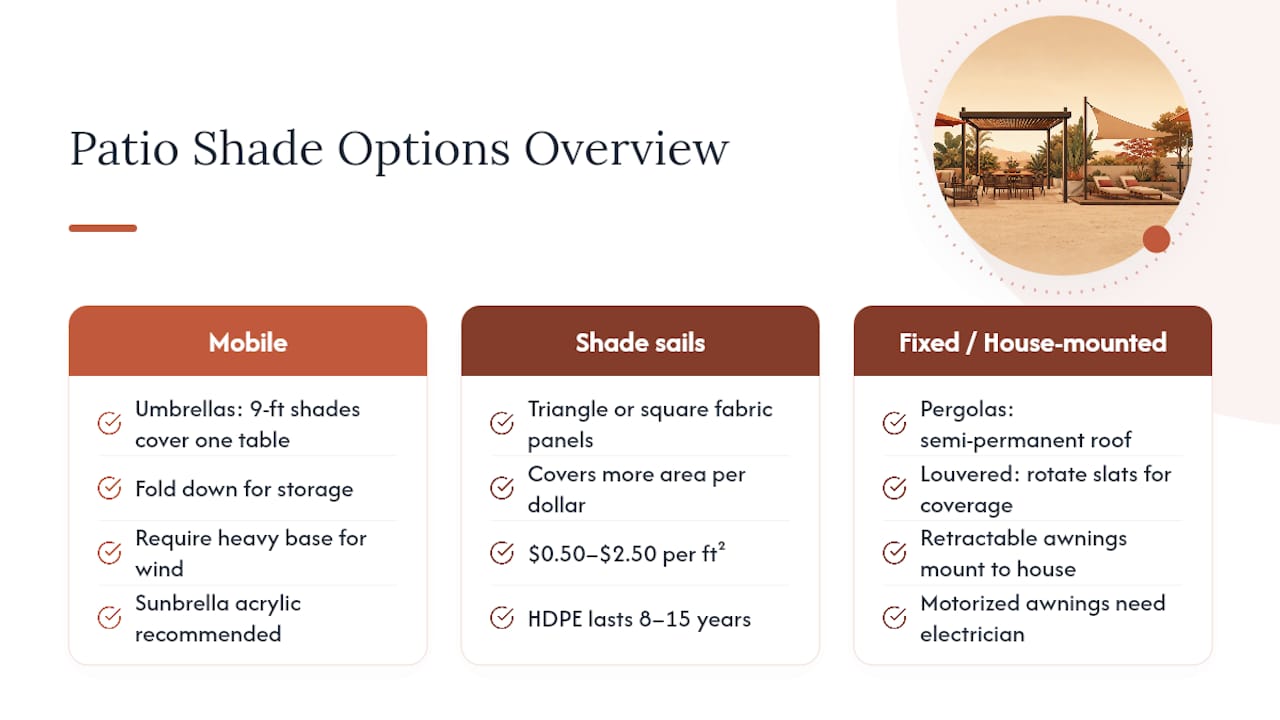
Pro Tip: Layering beats choosing just one. Pair a fixed shade sail over the lounge area with a cantilever umbrella over the dining table, or combine a pergola with roller shades along the house wall for side coverage. Layered shade gives you flexibility a single structure can’t.
How Do You Choose the Right Shade Solution?
- Measure your patio and track sun hours. Note which corners bake at noon and which stay shaded until 3 p.m.
- Identify your primary zone. Dining table, lounge chairs, or a small workout mat all call for different coverage shapes.
- Decide your permanence level. A landlord, a tight budget, or a storm-prone region all push you toward removable options.
- Match coverage shape to your furniture layout. Square sails suit square patios; cantilever umbrellas suit round tables set off to one side.
- Check your mount points. Fascia boards, brick walls, and freestanding posts all handle anchors differently, and some jobs genuinely need a professional.
- Add up the full cost. Product price is only part of it. Factor in installation, hardware, and yearly maintenance before you commit.
Do You Need a Permit for Patio Shade Structures?
Pergolas, fixed awnings, and large gazebos commonly require permits because they’re structurally attached or exceed a height threshold. Check with your local building department and your HOA before ordering anything permanent.
- HOAs often restrict fabric color, permanent fixtures, and maximum structure height.
- Concrete footings for posts, electrician fees for motorized awnings, and professional mounting all add to your budget beyond the product price.
- Anchor points need to handle real wind load. A sail or awning that isn’t properly tensioned and secured can tear loose in a storm.
What Materials Hold Up Best Outdoors?
Sunbrella and other solution-dyed acrylic fabrics resist UV fade and hold their color for years, while HDPE knit fabric is the standard for shade sails because it breathes and drains rain instead of pooling. PU-coated fabrics add waterproofing where you need actual rain protection, not just sun.
For frames, aluminum stays low-maintenance and resists rust. Powder-coated steel handles more structural weight. Treated wood looks the best but needs re-staining every couple of years.
- Clean fabric shades twice a year with mild soap and water.
- Re-tension shade sails each season as fabric naturally stretches.
- Store pop-up canopies and freestanding umbrellas indoors for winter.
Quality HDPE sails commonly carry UPF 50+ ratings, which blocks the vast majority of UV rays reaching your skin underneath. Fabric that’s lost its stretch or hardware showing rust is your cue to replace, not patch.
How Do You Pair Shade With Furniture and Layout?
- A small patio does best with a single cantilever umbrella over a compact outdoor sofa set, matching scale so neither piece overwhelms the space.
- A larger layout benefits from a shade sail over the lounge zone, a cantilever umbrella for dining, and roller shades along the house wall for late-day glare.
- Whatever you buy, match furniture rated for outdoor use to your shade fabric’s durability. A weather-resistant sofa under a cheap canopy that fades in one summer is a mismatched investment.
Does Patio Shade Affect the Plants Beneath It?
Shade changes what grows underneath, and that matters if your patio borders a garden bed or container plants. Full sun perennials like lavender or succulents will struggle under a permanent pergola cover or a dense shade sail, since they need 6 or more hours of direct light to thrive. Shift those plantings to the edges of your shaded footprint or swap them for shade-tolerant species like hostas, ferns, or hydrangeas that actually prefer the cover.
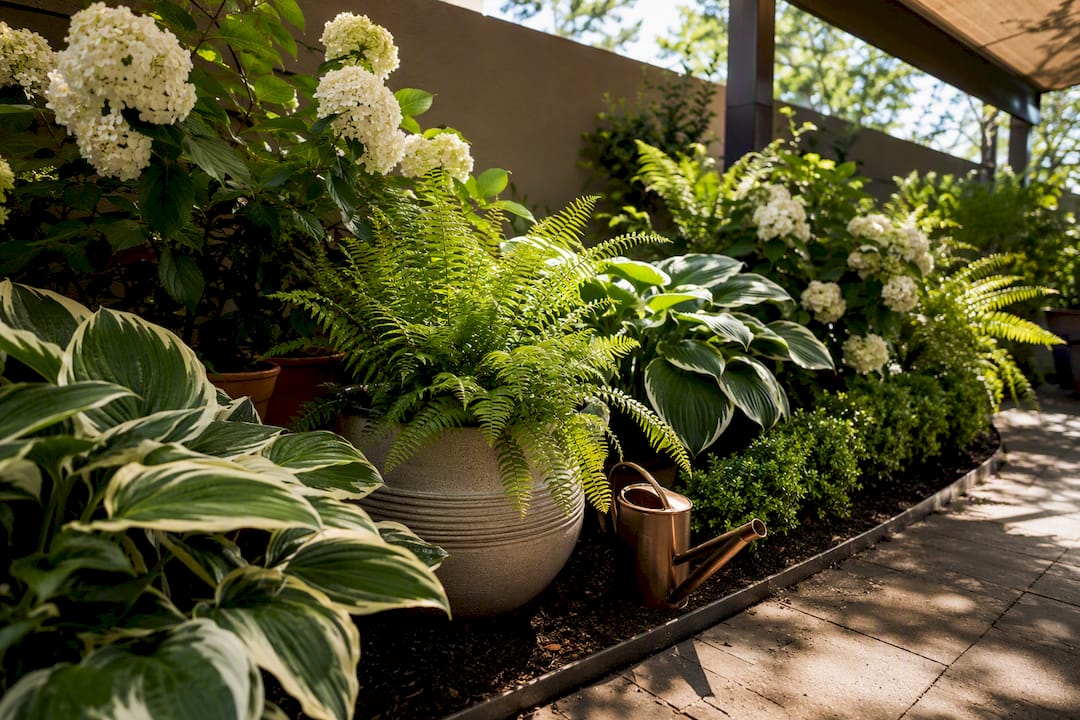
Retractable awnings and louvered pergolas offer a middle path here, since you can open them on cloudy days to let light through and close them during peak heat. Fixed structures like a permanent pergola roof or a taut shade sail don’t give you that flexibility. Plan planting beds accordingly before you install anything permanent.
Soil moisture also shifts under shade. Less direct sun means slower evaporation, so beds under a sail or pergola often need less frequent watering than beds in full sun. That’s a genuine upside for anyone tired of daily watering duty during peak summer. On the flip side, dense structures can block rainfall from reaching the soil directly beneath them, so container plants tucked under a solid roof may need manual watering even after a storm.
If you’re training vines across a pergola for extra shade, choose varieties suited to your climate. Fast growers like wisteria can eventually add real structural weight, so check your pergola’s load rating before committing to a heavy vine.
Can You Adjust Patio Shade as the Seasons Change?
The sun sits at a different angle in July than it does in October, and a shade solution that’s perfect in summer can feel like overkill by fall. Adjustable options solve that problem without asking you to rebuild anything.
Louvered pergolas let you rotate slats fully open in cooler months and closed tight during peak summer heat, which makes them the most seasonally flexible fixed structure available. Motorized retractable awnings offer similar range. Extend them fully on scorching afternoons and retract them entirely once the weather cools, all with a remote or wall switch.
Umbrellas and shade sails are seasonal in a simpler way: take them down. Most umbrellas fold flat for garage storage, and sails unclip from their anchor points in minutes. That’s actually an advantage in regions with real winter weather, since storing fabric shade prevents snow load damage and UV fabric doesn’t sit outside degrading during months nobody’s using the patio anyway.
Outdoor roller shades split the difference. They stay mounted year round but roll up completely when you want full sun, which makes them a low-effort way to fine-tune light without any seasonal teardown. If your patio sees genuinely different needs across the year, a layered approach, a fixed structure for baseline shade plus a movable piece for fine-tuning, gives you the most control without the cost of a fully motorized system.
What Wind and Fire Safety Rules Apply to Patio Shade?
Wind is the most common failure point for shade structures, and it’s also the most preventable one. Shade sails and awnings both rely on proper tensioning and anchor strength. A sail installed loose, or anchored into a post that isn’t rated for the load, can tear free in a strong gust and become a hazard rather than a convenience. Cantilever and market umbrellas need weighted bases heavy enough to resist tipping, since a lightweight base turns an umbrella into a projectile in a storm.
Motorized awnings and louvered pergolas typically include built-in wind sensors on higher-end models that retract automatically once gusts hit a certain threshold, which removes the guesswork of deciding when to bring shade in. Manual structures don’t have that safeguard, so it falls on you to watch weather forecasts and retract or remove shade before a storm arrives.
Fire retardance matters most for fabric near grills, fire pits, or outdoor heaters. Check any umbrella, sail, or awning fabric label for a flame-resistance rating before positioning it near an open flame source, and keep a minimum clearance regardless of the rating. Treated wood pergolas carry some fire risk near open flame too, while aluminum and steel frames don’t burn but can still scorch fabric attached to them. If your patio includes a fire pit or built-in grill, position any overhead shade well clear of direct heat and sparks, not just visually close to it.
Can Patio Shade Lower Your Cooling Costs?
Shade over a patio does more than make sitting outside comfortable. It changes how much heat your house actually absorbs. A patio that sits against an exterior wall or under windows radiates heat directly into your home’s interior once the sun hits it for several hours. Covering that space with a pergola, awning, or dense shade sail blocks a meaningful amount of that solar heat gain before it ever reaches your siding or glass.
Retractable awnings mounted over south or west facing windows are particularly effective here, since they intercept the sun before it hits the glass rather than trying to block heat after it’s already inside. That’s a different mechanism than interior blinds, which only manage heat that’s already made it through the window. Extending an awning during the hottest parts of the day and retracting it when the sun angle drops can noticeably reduce how hard your air conditioner has to work during peak summer afternoons.
Dense ground cover shade, like a pergola with a solid cover or a well-anchored shade sail over a patio slab, also reduces how much heat that concrete or paving surface radiates back toward the house in the evening. Concrete and stone hold heat and release it for hours after sunset, so shading that surface during peak sun hours cuts down on ambient heat buildup around your home’s exterior.
None of this replaces proper attic insulation or efficient windows, but it’s a legitimate, low-effort layer of savings on top of everything else. If your energy bills spike every July and August, the shade over your patio and the windows it faces is worth a second look before you assume the AC unit itself is the problem.
A Few Honest Thoughts on Getting This Right
Comfort matters more than perfection here. Prioritize durability and usability over the fanciest option, and set aside a distinct shaded corner for stretching or a quick workout, separate from your dining or lounge zone. Test a $50 umbrella before committing to a $5,000 pergola. You’ll learn more about your actual sun patterns from one summer than any planning app.
— Brian Dunn, Couch & Dumbbells
Complete Your Shaded Patio With the Right Furniture
Once you’ve settled on a shade solution, the furniture underneath is what actually makes the space livable. A cantilever umbrella over a compact seating area calls for pieces sized to match, while a shade sail over a bigger lounge zone can handle a fuller outdoor sofa set built for real weather exposure.
Outdoor furniture built to hold up under the same sun and rain your shade structure is fighting helps ensure you’re not pairing a durable pergola with a sofa that fades in one season. The seasonal PE wicker furniture set pairs especially well with a shade sail or pergola, since both are built to stay outside year round without losing their finish. If you’re starting with a smaller footprint, a compact outdoor set sized for tight patios keeps the scale right under a single cantilever umbrella. Browse the full outdoor furniture collection and match a set to the shade plan you’ve already picked out.
Sources
- Patio Umbrella vs Shade Sail — Comparison Guide
- Patio shades ideas — Beyond basics
- Smart ideas for patio shade — Gardening Know How
FAQ
What’s the Cheapest Way to Cover a Patio?
Pop-up canopies and basic market umbrellas are the cheapest options, typically running $30 to $250 with no installation required.
What Is the Best Outdoor Patio Shade Overall?
Shade sails offer the strongest balance of cost, coverage, and lifespan, running $0.50 to $2.50 per square foot and lasting 8 to 15 years on HDPE fabric.
What Is the Best Material for Patio Shades?
Sunbrella acrylic and HDPE fabrics hold up best against UV fade and outdoor wear, while UV-rated fabrics resist fading far longer than untreated alternatives.
How Do You Shade a Patio on a Budget?
Combine a pop-up canopy or umbrella with potted trees for natural, movable shade, and skip permanent structures until you know exactly how you use the space.
Do Retractable Awnings Need an Electrician?
Motorized retractable awnings typically require electrical work, while manual crank models install without one.