

For most buyers, top-grain leather hits the sweet spot of durability, look, and price. Full-grain is the premium choice worth the extra cost if you want decades of use and a rich patina. Corrected-grain works for busy households that need stain resistance, and bonded leather belongs nowhere near a sofa you plan to keep past a few years. How that leather is finished, whether it’s aniline or pigmented, changes how much upkeep it demands.
TL;DR:
- Top-grain leather with a pigmented or semi-aniline finish offers the best durability and stain resistance for households with kids or pets.
- Full-grain leather develops a rich patina over decades but is less suitable for high-traffic or messy environments due to its natural surface.
- Corrected-grain and split leathers prioritize practicality and stain resistance, but they lack the natural aging qualities of higher-grade leathers.
- “Genuine leather” is a marketing term that often refers to corrected or split leather and is not a quality indicator.
- Bonded leather typically fails within five years and should generally be avoided for long-lasting furniture investments.
Table of Contents
- Leather Sofa Grades Ranked: A Quick Cheat Sheet
- What Each Grade Actually Is
- How Finishing and Tanning Change the Way Leather Performs
- How to Identify a Leather Sofa’s Grade Yourself
- Choosing the Right Leather Grade for Your Household
- Care, Lifespan, and Cost-Per-Year by Grade
- Why You Can Trust This Guide
- Sustainability and Ethics in Leather Production
- Marketing Terms and Misconceptions Worth Watching For
- How Grade Affects Comfort and the Way a Sofa Ages
- An Editorial Take: What Actually Matters When You Buy
- Shop Leather Sofas That Match Your Grade Priorities
- Sources
- FAQ
Leather Sofa Grades Ranked: A Quick Cheat Sheet
Here’s how the five grades stack up when you line them up by how long they last and how they age. Think of this as your shortcut before you walk into a showroom or start scrolling product listings.
- Full-grain leather: The highest quality tier. Best for buyers who want an heirloom piece and don’t mind visible scars or grain variation. Price band: premium to luxury.
- Top-grain leather: The most common grade in mid-range and higher furniture. Best for households that want durability without the full-grain price tag. Price band: mid to upper-mid.
- Corrected-grain (often sold as “genuine leather”): Sanded, embossed, and coated for a uniform look. Best for families who need stain and scratch resistance over natural character. Price band: budget to mid.
- Split leather: Made from the lower layers of the hide, usually given a corrected or coated surface. Best for accent pieces or budget-conscious buyers who understand the tradeoff. Price band: budget.
- Bonded leather: Not really leather in any meaningful structural sense. Best avoided for a sofa; tolerable only for a low-use accent chair you’ll replace in a few years. Price band: lowest.
Notice that “genuine leather” sits near the bottom of this list, not the top. That single phrase confuses more shoppers than any other term in furniture marketing, and it’s worth remembering before you read a single product description online.
What Each Grade Actually Is
Leather grading comes down to one simple fact: not all parts of a hide are equal, and how a tannery processes that hide determines everything from how it feels under your hand to how it looks in ten years.
Full-grain: the untouched surface
Full-grain leather keeps the hide’s entire outer surface intact. Tanneries don’t sand it, buff it, or correct it in any way. Every natural mark from the animal’s life stays visible: healed scars, insect bites, subtle grain variation. That’s not a flaw. It’s the reason full-grain leather develops a deep, rich patina over years of use, and why it’s the longest-lasting upholstery leather available. The fibers at the top of the hide are the densest and tightest, which is exactly why manufacturers leave them alone rather than sanding them away. Furniture makers reach for full-grain when they’re building a flagship piece meant to be sold on longevity and character, not on uniform appearance.
Top-grain: the practical middle
Top-grain leather takes that same outer layer and lightly sands away just enough surface, typically 0.05 to 0.1 millimeters, to smooth out minor imperfections. It still retains most of the natural grain structure underneath, so it keeps a good deal of leather’s inherent strength and breathability. The tradeoff is a lighter patina than full-grain, since some of the surface character gets buffed away in the process. This is why top-grain shows up constantly in luxury and mid-tier furniture lines: it looks cleaner and more consistent on a showroom floor while still performing like real leather for years of daily use. If you’ve sat on a well-reviewed leather sofa in a furniture store, there’s a good chance it was top-grain.
Corrected-grain and split leather: engineered surfaces
Corrected-grain leather is a different animal entirely, even though it starts from the same hide. Tanneries sand off far more material, around 0.3 to 0.5 millimeters, to erase scars, wrinkles, and inconsistencies entirely. Then they emboss a fake, uniform grain pattern onto the surface and seal it with a thick pigmented coating, often 60 to 100 microns thick. That coating is doing real work: it resists stains and abrasion better than an untreated surface, which is genuinely useful for households with kids or pets. But it comes at a cost. Corrected-grain leather doesn’t develop a patina because the natural surface is gone, replaced by a manufactured layer. When that coating eventually cracks or peels, and it will over years of flexing and sun exposure, there’s no natural leather surface underneath to fall back on. You’re left looking at peeling plastic-like patches instead of graceful wear.
Split leather takes this a step further. Once a hide is sliced into layers, the top layer becomes full-grain or top-grain material, and the lower, looser-fibered layers become “splits.” These splits have little natural strength or grain pattern, so they almost always get corrected, embossed, and coated to look presentable. Manufacturers use split leather for lower price points or for parts of a sofa that see less wear, like the back panels or sides, while reserving better material for seat cushions.
Genuine leather: a marketing term, not a quality tier
Here’s where a lot of confusion creeps in. “Genuine leather” sounds like it should mean something premium, but it’s a loosely applied marketing term that usually just means the product contains real animal hide somewhere in its construction, often corrected or split leather. It is technically leather. It is not a marker of high quality, and treating it as one is one of the most common buying mistakes people make.
Bonded leather: not structurally leather at all
Bonded leather takes actual leather, but only in the form of scraps and shavings left over from other manufacturing processes, and binds them together with polyurethane. The result performs much more like a synthetic material than genuine hide. Lifespans often run under five years for upholstery use, and peeling is less a risk than an eventuality. Manufacturers use it because it’s cheap to produce and can be printed with a convincing grain texture, which is exactly why it shows up so often on low-price sofas marketed with leather-heavy language.
How Finishing and Tanning Change the Way Leather Performs
Grade tells you where the leather came from on the hide. Finish tells you how it was treated afterward, and that second factor often matters more for day-to-day living than the grade itself.
Aniline leather is dyed with soluble dyes and gets no protective surface coating. You see the hide’s natural markings and texture directly, and it develops the richest, most authentic patina over time. The downside is low stain resistance. A glass of red wine on aniline leather is a real problem. Semi-aniline adds a light protective topcoat, giving you a modest buffer against spills while keeping most of the natural hand-feel. Pigmented (or protected) finishes go furthest, adding a durable surface layer that resists stains and abrasion at the cost of that natural, breathable feel. A pigmented finish over top-grain leather is a common combination in family-friendly furniture, and it’s not a bad one.
Tanning method matters too. Chrome tanning is fast, consistent, and dominates furniture production because it’s predictable at scale. Vegetable tanning uses natural tannins, takes considerably longer, and costs more, but it tends to produce leather that ages with a warmer, richer patina. You’ll see vegetable tanning more often paired with full-grain leather in higher-end pieces, since neither the process nor the material makes sense on a budget product.
How to Identify a Leather Sofa’s Grade Yourself
You don’t need a lab to figure out what you’re sitting on. A combination of a few simple checks will tell you almost everything you need to know, and no single test is conclusive on its own.
- The absorption test. Press a slightly damp finger against the leather in an inconspicuous spot. Full-grain and top-grain leather will darken slightly as they absorb a bit of moisture. Corrected or coated leather stays unchanged because the pigmented layer seals the surface.
- The visual grain check. Look closely at the surface pattern under good light. Natural full-grain shows irregular pores, subtle scars, and variation from panel to panel. Corrected-grain shows a suspiciously uniform, repeating texture, since it’s embossed rather than natural.
- The surface feel and bead test. Run your palm across the material. Full and top-grain feel slightly different panel to panel and have a warmer, more organic hand-feel. A heavily coated surface feels more uniform and slightly plasticly, almost like a very good vinyl.
- The edge and thickness inspection. Check a seam or an underside edge where you can see a cross-section. Thicker, fibrous, uneven edges suggest full-grain or top-grain. Thin, layered, or oddly consistent edges point toward split or bonded construction.
No single test settles the question, but running all four together usually gets you a confident answer. If two or three results point the same direction, trust that pattern over any one result.
Pro Tip: Ask the retailer for a spec sheet before you buy. Reputable sellers can tell you the hide origin, finish type, and tanning method in writing. If a salesperson can’t answer basic questions about the leather grade, that’s a signal worth paying attention to on its own.
Choosing the Right Leather Grade for Your Household
The right grade depends less on what looks best in a showroom and more on how your living room actually gets used. Match the material to your real routine, not the version of your life you’re hoping to have.
- Kids, pets, or heavy daily traffic: lean toward top-grain or corrected-grain with a pigmented finish. The stain and scratch resistance will save you real frustration.
- A formal or low-traffic living room: full-grain aniline leather makes sense here, since you’re not fighting spills and scuffs every week.
- Tight budget but you still want real leather: top-grain with a semi-aniline or pigmented finish gets you genuine durability without luxury pricing.
- You want the sofa to double as workout-adjacent seating: a protected finish resists sweat and friction far better than an unfinished aniline surface, which matters if your living room doubles as a home gym corner.
Before you buy, ask the retailer three things: what finish is on the leather, what the warranty actually covers, and whether the leather can be professionally repaired or refinished if it’s damaged. A “no” on that last question is worth knowing before you sign a receipt, not after.
Sometimes the smarter move is skipping leather altogether. A high-performance fabric sofa with a durable weave and stain-resistant treatment can outperform low-grade or bonded leather for the same money, especially in households where spills are a weekly event rather than a rare accident.
Care, Lifespan, and Cost-Per-Year by Grade
Maintenance scales with grade, but not in the direction people expect. Full-grain and top-grain leather need light conditioning every six to twelve months and a wipe-down with a damp cloth for spills. Corrected and coated leathers need less conditioning since the pigmented layer isn’t absorbing anything, but that same layer can’t be restored once it starts to fail. When a pigmented finish breaks down, it peels in visible patches. When full-grain leather wears, it develops patina instead, deepening in color and softening slightly without structurally failing.
Lifespan differences translate directly into value. Higher-grade leather often delivers better cost-per-year value despite a higher sticker price, simply because it lasts so much longer. A full-grain sofa costing considerably more than a bonded-leather equivalent can still work out cheaper per year of use if it lasts two or three times as long. Bonded leather, by contrast, frequently needs replacing within five years, while full-grain and top-grain pieces routinely serve households for well over a decade with basic care. Run the math yourself before assuming the cheaper price tag is the better deal.
For general upholstered furniture, the same conditioning and dust-removal habits that keep fabric chairs looking fresh apply loosely to leather care routines too: regular light cleaning prevents the kind of buildup that accelerates wear on any upholstery material.
Why You Can Trust This Guide
This guide comes from Belle, part of the Couch & Dumbbells editorial team, where furniture curation and home-design content sit alongside fitness gear because we believe a well-built living room supports both rest and activity equally well.
Grading claims in leather furniture get thrown around loosely enough that “genuine leather” has become almost meaningless as a quality signal. Our approach is to explain the hide science plainly, so a reader can walk into any store or open any product page and evaluate a sofa on its actual construction, not its marketing copy.
The home and interior selection on Couch & Dumbbells is curated with attention to grade transparency, finish clarity, and expected lifespan.
Sustainability and Ethics in Leather Production
Leather grade and environmental impact are connected, but not in the way most people assume. Higher grades aren’t automatically the more sustainable choice, and lower grades aren’t automatically worse.
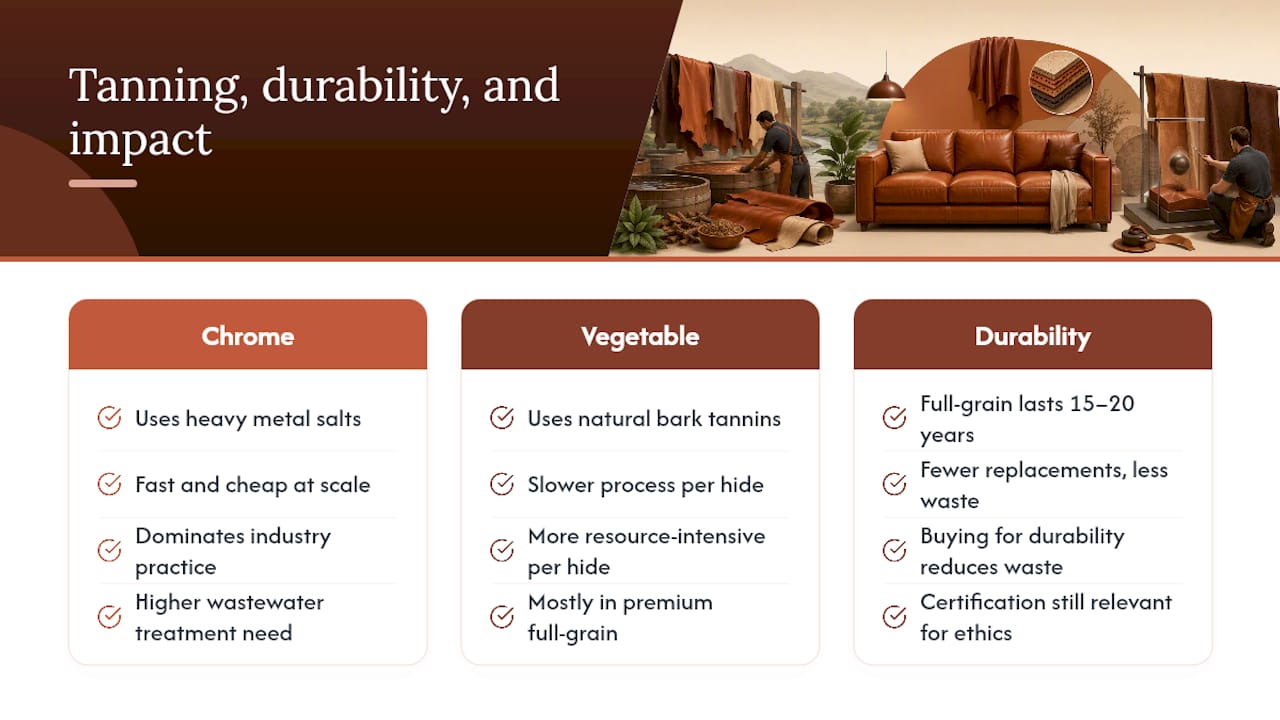
Tanning chemistry matters more than grade for environmental impact. Chrome tanning uses heavy metal salts and requires careful wastewater treatment, and it dominates the industry because it’s fast and cheap at scale. Vegetable tanning relies on natural tannins from bark and plant matter, which generally means a lower chemical footprint, but it’s slower, more resource-intensive per hide, and considerably more expensive, which is part of why it’s reserved mostly for premium full-grain products.
Longevity itself is an environmental argument worth taking seriously. A full-grain sofa that lasts fifteen or twenty years puts far less material into landfills over time than three or four bonded-leather sofas replaced every few years. Buying for durability is, in a real sense, buying for less waste.
On the ethical side, most upholstery leather is a byproduct of the meat industry rather than the primary reason animals are raised, which shifts some of the ethical weight of the material. Buyers concerned about animal welfare and tannery labor conditions increasingly look for third-party certifications from groups like the Leather Working Group, which audits tanneries for environmental compliance. Asking a retailer whether their leather is Leather Working Group certified is a fair, specific question, and one most budget furniture sellers won’t be able to answer.
Marketing Terms and Misconceptions Worth Watching For
“Genuine leather” is the single most misleading phrase in furniture marketing, and it deserves repeating: it signals real leather content, not quality. It’s frequently applied to corrected or split leather that sits closer to the bottom of the grade hierarchy than the top, despite sounding authoritative on a product tag.
“Italian leather” is another phrase that promises more than it delivers. It usually refers to where the leather was tanned or finished, not the grade of the hide or the quality of the animal source. A corrected-grain, bonded, or even synthetic-blend product can carry an “Italian leather” label if part of the finishing process happened there. The phrase tells you almost nothing about durability.
“Full-grain look” or “top-grain feel” are phrases retailers use on lower-grade products to borrow credibility from higher grades without technically claiming to be one. If a listing describes a “look” or a “feel” rather than stating the grade directly, treat that as a signal to ask more questions, not fewer.
The fix for all of this is the same: skip the adjectives on the tag and ask directly for hide origin, finish type, and tanning method in writing. A retailer who can answer plainly is worth your business. One who can’t is worth a second look elsewhere.
How Grade Affects Comfort and the Way a Sofa Ages
Grade shapes more than durability. It shapes how a sofa feels to sit on today and how it will feel to sit on in ten years, which is a different question than most buyers think to ask.
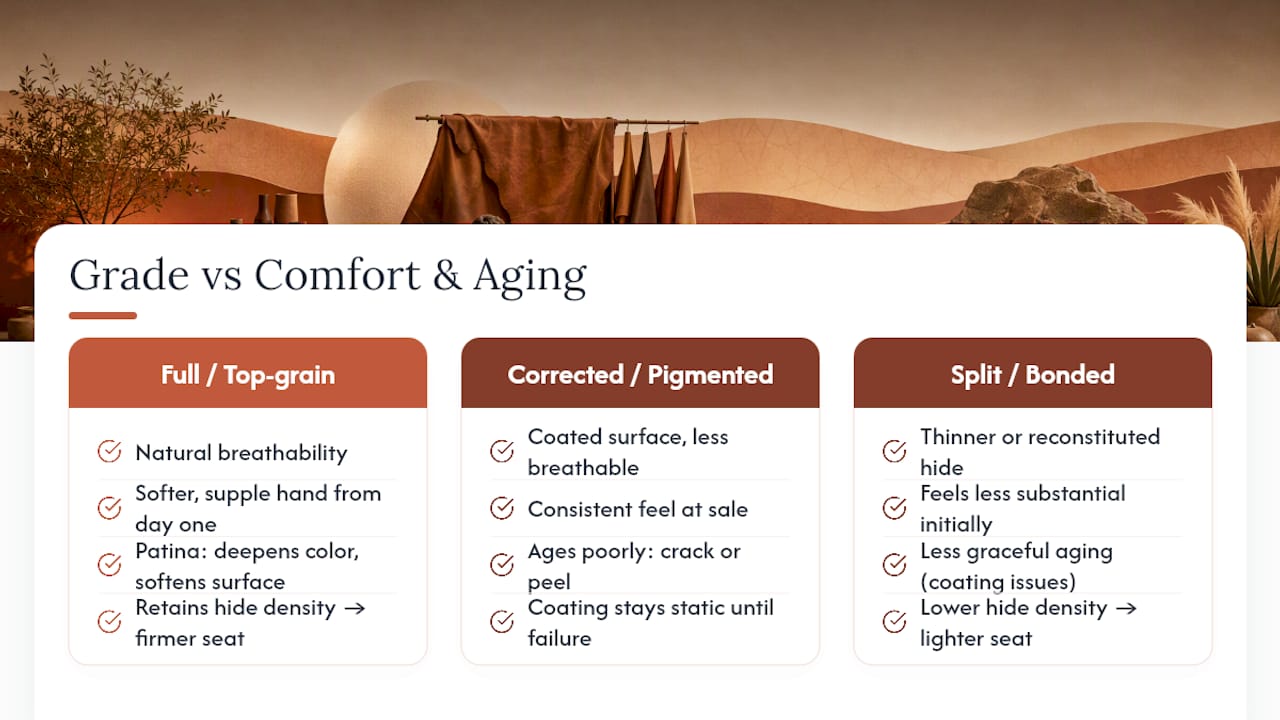
Full-grain and top-grain leather retain natural breathability, since their fiber structure hasn’t been sealed under a heavy coating. That means less temperature buildup against skin in warm weather and a softer, more supple hand-feel from day one, one that only improves as the leather flexes and absorbs natural body oils over years of use. That’s the patina effect in practice: color deepens, the surface softens, and creases at seating points start to look intentional rather than worn.
Corrected-grain and pigmented leather feel more consistent at the point of sale, but that consistency doesn’t evolve the same way. The coating stays largely static until it starts to fail, at which point the aging process isn’t graceful, it’s a crack or a peel appearing somewhere on the surface with little warning. There’s no in-between stage where it looks “nicely worn.”
Comfort-wise, thickness plays a role too. Full-grain and top-grain retain more of the hide’s natural density, giving seat cushions a firmer, more substantial feel under body weight. Split and bonded leather, built from thinner or reconstituted material, often feel noticeably less substantial, even when a cushion’s foam filling is identical. If a sofa feels oddly light or flat when you press on it in a showroom, the leather grade underneath the surface is often part of the reason.
An Editorial Take: What Actually Matters When You Buy
Most leather sofa advice fixates on grade alone, as if picking full-grain automatically guarantees a good outcome. It doesn’t. A poorly finished full-grain sofa in a household with two dogs and three kids can age worse than a well-finished top-grain piece in the same room. Finish and household fit matter as much as grade, sometimes more.
The conventional wisdom oversells full-grain as the universal right answer. It’s the right answer for a formal room or a buyer who values patina over practicality. For most real households, top-grain with the correct finish is the more honest recommendation, and I’d argue trade guides underweight this because full-grain sounds more impressive to sell.
If you take one thing from this guide, prioritize asking for the finish type before you ask about grade. A pigmented top-grain sofa will outlast an unfinished full-grain sofa in a chaotic household, even though full-grain wins on paper.
— Brian Dunn, Couch & Dumbbells
Shop Leather Sofas That Match Your Grade Priorities
Once you know which grade fits your household, the next step is finding it without wading through vague product descriptions. Some home and interior collections are organized with grade transparency in mind, allowing shoppers to filter toward the right fit instead of guessing from a stock photo.

If you’re prioritizing budget and durability, look for top-grain pieces with a pigmented or semi-aniline finish, the combination that handles daily household life without falling apart in a few years. If you’re shopping for a statement piece meant to age beautifully, filter toward full-grain aniline options built for long-term patina rather than short-term uniformity. Browse the full Home & Interior collection and check each listing’s finish and grade details before adding anything to your cart. Start there, compare a few options side by side, and you’ll have a shortlist within minutes instead of hours.
Sources
The grading and finish claims in this guide draw on trade and consumer research specific to leather furniture. For deeper technical detail, these sources are worth reading directly:
Manufacturer spec sheets and Leather Working Group certification records are worth checking directly whenever a specific sofa is under consideration.
FAQ
What are the five grades of leather?
The five grades relevant to sofas are full-grain, top-grain, corrected-grain, split leather, and bonded leather, ranked roughly in that order from highest to lowest quality and longevity.
How can you tell if a leather couch is high quality?
Combine the absorption test, a close visual check of the grain pattern, a feel test across the surface, and an edge inspection at a seam. Full-grain and top-grain will darken slightly with moisture, show natural grain variation, and reveal thicker, fibrous edges.
What are the three grades of leather?
When people simplify the hierarchy, they usually mean full-grain, top-grain, and corrected-grain (sometimes called “genuine leather” in marketing), since these three account for most furniture on the market.
What does “leather grade C” mean?
There’s no standardized “grade C” system in furniture leather. That label sometimes appears in raw hide sorting within tanneries, referring to imperfection count, but it’s not a consumer-facing grade you’ll see used consistently on furniture listings.
Is genuine leather actually good quality?
Not necessarily. “Genuine leather” is a marketing term that typically describes corrected or split leather, and it sits closer to the lower end of the quality hierarchy despite how the phrase sounds.
Should I avoid bonded leather entirely for a sofa?
For a sofa you plan to keep for more than a few years, yes. Bonded leather often peels and fails within five years of normal use, making it a poor long-term investment compared to top-grain or full-grain options.