

The most reliable setup for most home gyms is an exterior vented exhaust fan paired with a circulation fan and a room dehumidifier, run during your workout and for 45 to 90 minutes after. If sweat and heat still linger, consider upgrading to more advanced HVAC solutions like mini splits or ERVs. Basic setups cost a few hundred dollars, while dedicated systems typically cost more.
TL;DR:
- Use an exterior vented exhaust fan ranging from 150 to 300 CFM, especially if your room experiences heavy sweating or high humidity during workouts.
- Pair a 30 to 50 pint dehumidifier with your ventilation to keep humidity around 50% and run it during and for at least 45 to 90 minutes after exercising.
- Measure room volume and train style to select appropriate equipment, with larger or more intense workouts requiring stronger airflow and moisture control systems.
- Position circulation fans to move fresh air without short-circuiting the exhaust, targeting high-sweat zones for targeted relief and noise levels below 3 sones.
- Prioritize a hygrometer to verify humidity levels before investing in HVAC upgrades or additional ventilation systems.
Table of Contents
- Your Quick-Win Home Gym Ventilation Checklist
- How Do You Evaluate Your Home Gym Space?
- Which Mechanical Options Actually Solve Home Gym Ventilation?
- How Should You Position Fans for Better Air Circulation?
- What CFM, BTU, and Pint Ratings Should You Target?
- How Do You Control and Verify Your Ventilation Setup?
- What Mistakes Quietly Undo Your Ventilation Upgrades?
- How Do You Keep a Ventilated Gym Looking Good?
- Why Most Ventilation Advice Skips the Part That Matters Most
- Furnish and Equip a Home Gym That Breathes and Looks Great
- Sources
- FAQ
Your Quick-Win Home Gym Ventilation Checklist
You don’t need to overhaul your whole basement to feel a difference this week. Start with the moves that give you the most comfort per dollar spent.
- Install (or hire out) an exhaust fan that vents to the exterior, not into an attic or crawl space.
- Run a 30 to 50 pint dehumidifier in the room during and after workouts.
- Add a ceiling or box fan for air movement, since moving air feels cooler even at the same humidity.
- Buy a $10 to $15 hygrometer so you’re reacting to real numbers, not guesswork.
Opening a window helps when the outdoor air is cooler and drier than your indoor air. It backfires in humid summer weather or freezing winter conditions, when you’re either inviting moisture in or losing heat you’re paying to keep. Aim for exhaust fans in the 150 to 300 CFM range for a typical home gym, as HVAC planning guidance for gym spaces recommends, and size your dehumidifier for the room class you’re working with, covered below.
How Do You Evaluate Your Home Gym Space?
Before buying anything, spend ten minutes measuring your room. Multiply square footage by ceiling height to get cubic volume. A 12x15 foot room with 8 foot ceilings is 1,440 cubic feet, a number you’ll need for sizing exhaust fans and dehumidifiers correctly. Note whether you have an operable window, an exterior wall you can duct through, or neither.
Next, be honest about how you actually train. Light stretching and mobility work generate modest heat and moisture. Heavy cardio, circuit training, or a garage gym with two or three people lifting at once produces far more of both. A sealed 350 square foot basement gym can climb 5 to 8°F in temperature and jump from 45% to over 65% humidity in just 30 minutes of exercise, which tells you why “it’s just a small room” is not the same as “it needs less ventilation.”
Finally, check your HVAC access. Do you have a dedicated supply and return, or is the room fed by a single vent off the main system? Can you run ductwork to an exterior wall without cutting through joists or finished ceilings? And if there’s a gas water heater, furnace, or other fuel-burning appliance nearby, factor that into any exhaust plan so you’re not accidentally pulling combustion air the wrong direction.
Which Mechanical Options Actually Solve Home Gym Ventilation?
Every home gym ventilation upgrade falls into one of a few categories, and picking the right one depends on your room’s size, your workout intensity, and how much you’re willing to spend.
Exhaust fans are the starting point for almost every setup. Inline duct fans tend to move more air more quietly than wall-mounted units, and both should terminate outside the house through a backdraft damper that stops outside air (and pests) from creeping back in. For most home gyms, 150 to 300 CFM covers the job, with the higher end reserved for rooms where workouts spike humidity and CO2 well beyond a resting baseline.
Dehumidifiers do the heavy lifting on moisture. A 30 to 50 pint portable unit handles most garage or basement gyms, and it should run during your workout and for at least an hour afterward, holding the room around 50% relative humidity. Watch drainage, since a unit without a gravity drain or a condensate pump means emptying a tank daily. Compressor units also throw off a small amount of heat as they run, which matters in a tight, already-warm space.
Mini splits make sense once you’re training in that room daily and the space runs hot year round. A ductless system in the 12,000 to 18,000 BTU range typically handles dedicated temperature and humidity control for a standard-size home gym, as one framework for tiered gym HVAC solutions lays out.
ERV/HRV systems earn their cost in tightly sealed, energy-efficient homes where opening a window isn’t realistic and you want continuous fresh air exchange without losing conditioned air. If you train multiple times a day or share the space with training partners, this tier pays off.
Portable AC units cool a room fast but often add humidity back into the air through their exhaust hose setup, so they’re a stopgap, not a fix.
Pro Tip: If your equipment closet is smaller than about 1,000 cubic feet, a compressor dehumidifier will cycle inefficiently and struggle to keep up — a desiccant unit performs better in small, cold, or sealed enclosures.
How Should You Position Fans for Better Air Circulation?
Ventilation moves stale, humid air out. Circulation moves fresh air around so no corner of the room feels stagnant. You need both.
- Ceiling fans handle whole-room airflow; set the blades to spin counterclockwise in warmer months to push a cooling breeze downward.
- High-velocity floor or box fans work well pointed directly at cardio equipment or a lifting platform, giving you targeted relief where you sweat the most.
- Place fans so they don’t blow directly across your exhaust fan’s intake, which short-circuits the exhaust path and leaves other corners of the room stale.
- Ceiling fans move air well but don’t remove moisture, so they’re a complement to a dehumidifier, never a replacement for one.
On noise, look for fans rated below 3 sones for a home gym, comparable to a quiet library. Anything louder competes with music or a training partner’s coaching cues.
What CFM, BTU, and Pint Ratings Should You Target?
A 1,500 cubic foot gym benefits from roughly 4 to 6 air changes per hour during workouts, which works out to an exhaust fan somewhere in the 100 to 250 CFM range depending on ceiling height and room shape. For mini splits, plan on roughly 20 BTU per square foot for a moderately insulated space, adjusted upward for garages or rooms with poor insulation and heavy equipment use.
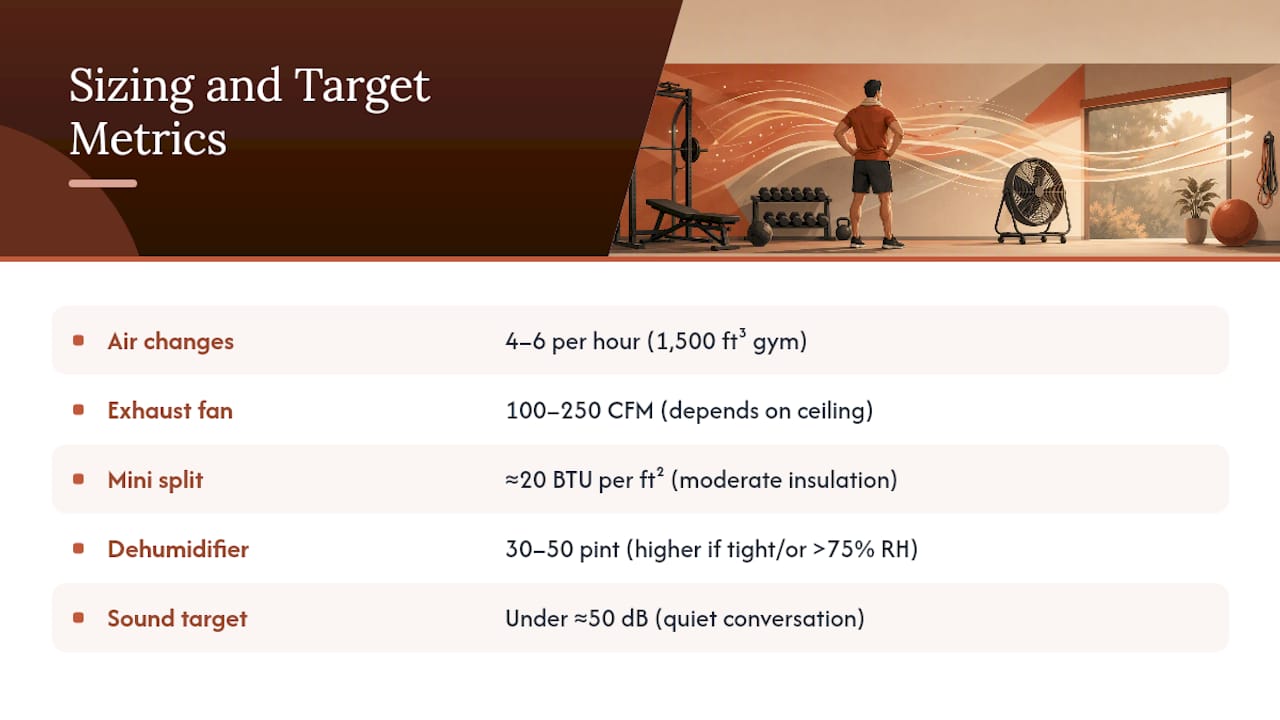
Dehumidifier sizing follows the room’s humidity behavior rather than square footage alone. A standard basement or garage gym typically calls for a 30 to 50 pint unit, and small, poorly sealed enclosures can spike above 75% relative humidity within 20 minutes of exercise, which pushes you toward the higher end of that range or a desiccant unit if the space is unusually tight. For sound, keep dehumidifiers and fans under roughly 50 dB, about the volume of a quiet conversation, so the equipment doesn’t compete with your workout.
How Do You Control and Verify Your Ventilation Setup?
A timer or humidity sensor that runs your fans and dehumidifier for 45 to 90 minutes after you finish training catches the moisture that keeps releasing into the air even after you’ve toweled off.
If more than one person trains in the room, or the sessions run long and intense, add a CO2 sensor. Elevated CO2 in a sealed room can affect alertness during a workout, worth watching in any multi-user setup.
- Do a simple before/during/after check with a $20 to $30 hygrometer and thermometer.
- A basic verification test: run a 30-minute workout with your ventilation active, then check readings, aiming for less than a 3°F temperature rise and under 10% humidity rise, with CO2 staying below roughly 1,000 ppm.
- Smart plugs and app-based controllers add convenience, but a $15 mechanical humidistat does the same core job.
Pro Tip: Tape a sticky note with your target humidity range right on the dehumidifier. It sounds simple, but it keeps you from ignoring the display for weeks at a time.
What Mistakes Quietly Undo Your Ventilation Upgrades?
The single most common mistake is venting an exhaust fan into a soffit, an adjacent unfinished basement, or a laundry room instead of straight outside. That just relocates the moisture problem instead of removing it, and it can quietly feed mold growth somewhere you’re not checking.
Every exterior termination point needs a backdraft damper, and every dehumidifier needs its drain line checked and its filter cleaned on a regular schedule, since a clogged filter drags efficiency down fast. Give ductwork a look twice a year for dust buildup.
Seasonal blind spots trip people up too. Running an exhaust fan hard through a dry winter can actually strip too much humidity from the room; dial it back and lean on your circulation fan instead. If humidity or odors persist after a full upgrade, the room’s volume was probably underestimated, or the exhaust fan is undersized for how intensely you actually train.
How Do You Keep a Ventilated Gym Looking Good?
Function and looks don’t have to fight each other. Run ducting through a closet wall or behind a floating shelf instead of exposed across the ceiling, and choose a slim inline fan over a bulky wall unit if visible hardware bothers you.
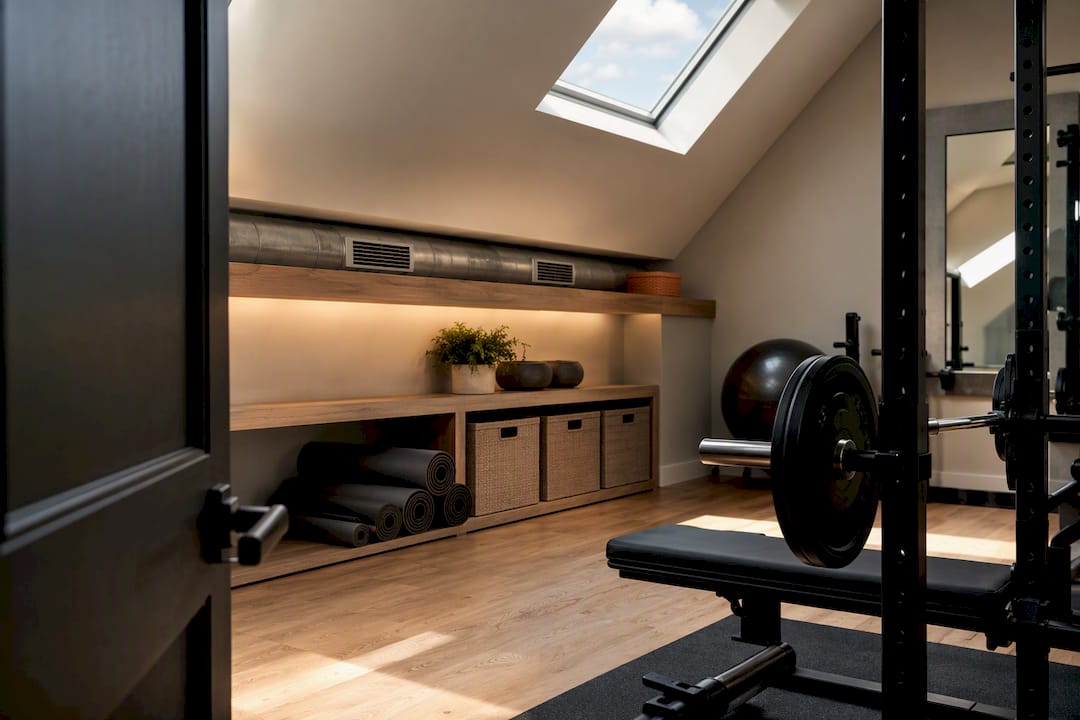
Keep airflow paths clear by raising storage off cold basement floors and organizing weights and mats along walls rather than in the room’s center, where they can block a fan’s throw. A few design ideas for aesthetically pleasing home gyms show how storage and layout choices keep a space breathing well and looking intentional at once. Compact, portable equipment and smart devices make it easier to keep floors clear without sacrificing the gear you actually use.
Why Most Ventilation Advice Skips the Part That Matters Most
The gap in most home gym ventilation advice is that it treats the exhaust fan as the finish line. It isn’t. Moisture keeps releasing from your skin, your gear, and even the floor for a good hour after you’ve stopped moving, which is exactly why the 45 to 90 minute post-workout run time matters more than the size of the fan you bought.
The other place conventional advice falls short is treating every basement gym the same. A 10 by 10 foot equipment closet with a single kettlebell rack has completely different needs than a 400 square foot garage where three people train together on leg day. Sizing by square footage alone, without accounting for how many people sweat in that room and how hard, leads to underpowered systems that “should” work on paper and don’t in practice.
If you’re prioritizing one thing first, make it the hygrometer, not the fan. A $15 sensor tells you whether your existing setup is actually working before you spend money assuming it isn’t. Most upgrade regret comes from skipping that step entirely.
— Brian Dunn, Couch & Dumbbells
Furnish and Equip a Home Gym That Breathes and Looks Great
Getting your air right is half the job. The other half is making the room feel like somewhere you actually want to train. Though ventilation work is best left to HVAC professionals, there are many options for furnishing and equipping your gym once the air is handled.

Browse Fitness & Gear for compact, portable equipment that keeps floor space clear so your circulation fan can actually do its job, plus a fitness smartwatch if you want to track your own heart rate and effort alongside the room’s humidity readings. For the storage and layout side of things, the Home & Interior collection has shelving and decor pieces that keep gear organized without blocking airflow paths. If sweat-wicking gear matters to your comfort as much as the room’s humidity does, a pair of men’s fitness pants built for breathability rounds out the setup nicely.
Sources
- Home Gym Ventilation: HVAC for 600W+ Heat Output | RenoHouse
- Indoorhumidity
- Compressor vs. desiccant dehumidifiers | Honeywell
FAQ
What Temperature Is Too Hot for a Home Gym?
Most people start losing performance and comfort once a room climbs past 75°F during exercise; a properly ventilated gym should hold a rise of no more than about 3°F above room temperature during a 30-minute session.
What’s the Best Mini Split Size for a Garage Gym?
A ductless mini split in the 12,000 to 18,000 BTU range covers most standard garage gyms, though poorly insulated garages or heavy multi-person use may need the higher end of that range or a second head.
What’s the Best Fan for a Home Gym?
A ceiling fan handles whole-room air movement, while a high-velocity box fan gives targeted cooling near cardio equipment. Look for units rated under 3 sones so noise doesn’t compete with your workout, and pair either fan with a dehumidifier since fans alone don’t remove moisture.
Is It Good to Run a Fan While Working Out?
Yes.
How Long Should a Dehumidifier Run After a Workout?
Run it during your session and for another 45 to 90 minutes afterward, since sweat and residual moisture keep releasing into the air well after you’ve stopped exercising.